























Odisha’s decision to restore original Odia place names is a step towards preserving linguistic heritage, cultural identity and decolonising public memory
Bhaskar Parichha
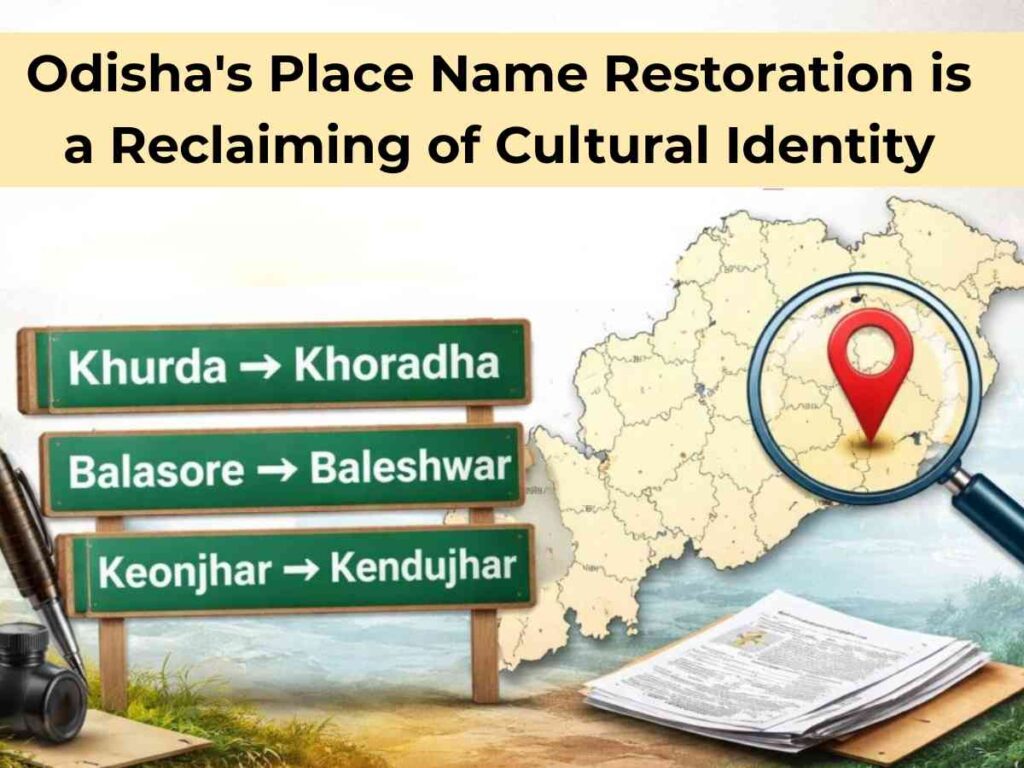
The Odisha government’s decision to restore the original Odia spellings of 64 places across the state is far more than an exercise in administrative correction. It is a cultural statement, a linguistic reclamation, and an attempt to repair a historical distortion that has lingered long after colonial rule ended.
For generations, Odias have lived with place names that often bore only a faint resemblance to their original pronunciation. Names such as Cuttack, Balasore, Angul, Berhampur, Deogarh, Keonjhar, and Jeypore entered official records through the filters of colonial administration, which transliterated local words according to English phonetics rather than Odia linguistic conventions. The result was a map populated by names that were familiar in official documents but alien to the language and culture from which they originated.
The cabinet’s decision to restore spellings such as Kataka, Baleshwar, Anugola, Brahmapur, Debagada, Kendujhar, and Jayapur seeks to bridge this gap between official nomenclature and cultural authenticity. Critics may dismiss the move as symbolic, but symbols matter. Names are not mere labels; they are repositories of history, memory, and identity. A place name often carries traces of geography, mythology, local traditions, and centuries of linguistic evolution. Altering it can weaken the connection between a community and its past.
The debate over place names is hardly unique to Odisha. Across India, cities and towns have reclaimed indigenous names after decades or even centuries of colonial usage. Bombay became Mumbai, Calcutta became Kolkata, Madras became Chennai, and Bangalore became Bengaluru. Each change sparked discussion about identity, practicality, and politics. Yet over time, these restored names have come to be widely accepted because they better reflect local history and pronunciation.

Odisha’s initiative belongs within this broader national effort to decolonize public memory. The British administration governed through a language that often struggled to accommodate Indian sounds and scripts. Many place names were simplified, modified, or entirely transformed to suit English-speaking officials. These spellings then became embedded in maps, railway schedules, postal records, and government correspondence. Independence brought political freedom, but many linguistic legacies of colonial rule remained untouched.
What makes the Odisha government’s approach noteworthy is the process it adopted. Rather than imposing changes unilaterally, it sought reports from district collectors, public representatives, and citizens. A committee headed by renowned litterateur and Jnanpith awardee Dr. Pratibha Ray examined the proposals, placed recommendations in the public domain, and incorporated public feedback before arriving at the final list. Such consultation lends legitimacy to the exercise and demonstrates that linguistic heritage is not merely a governmental concern but a public one.
At the heart of the decision lies the concept of Odia Asmita—the collective cultural identity of the Odia people. In recent years, discussions about language and regional identity have acquired renewed significance in Odisha’s public discourse. The preservation of the Odia language and culture cannot be limited to literature, education, or festivals alone. It must also be reflected in the names of towns, villages, rivers, and landmarks that people encounter every day.
Of course, challenges remain. Updating official records across multiple agencies, changing signboards, modifying maps, and ensuring consistency in digital databases will require time and coordination. There may also be temporary confusion among travelers, businesses, and institutions accustomed to the older spellings. Yet these are logistical hurdles rather than substantive objections. Similar transitions elsewhere in India have demonstrated that administrative systems eventually adapt.
The more important question is whether societies should have the right to represent themselves in their own linguistic terms. The answer is undoubtedly yes. Language is not static; it evolves alongside the communities that speak it. If colonial spellings no longer reflect the phonetic realities of Odia, retaining them merely for convenience perpetuates a historical inaccuracy.
The restoration of Odisha’s place names is therefore not about erasing history but correcting it. Colonial spellings will continue to exist in archives and historical records, reminding future generations of a particular period in the state’s past. What changes is the state’s assertion that its public identity should be shaped by its own language rather than inherited distortions.
In regaining names such as Kataka, Baleshwar, Brahmapur, and Kendujhar, Odisha is recovering something larger—the right to speak in its own voice. In a multilingual nation where language remains one of the strongest markers of cultural belonging, that voice deserves to be heard clearly and authentically.
(The author is a senior journalist and columnist. Views expressed are personal.)