



















Explore Odisha’s journey from 1450 to 1947. A review of Bhaskar Parichha’s book on the Gajapati Empire, British rule, and the fight for Odia independence
Snehaprava Das
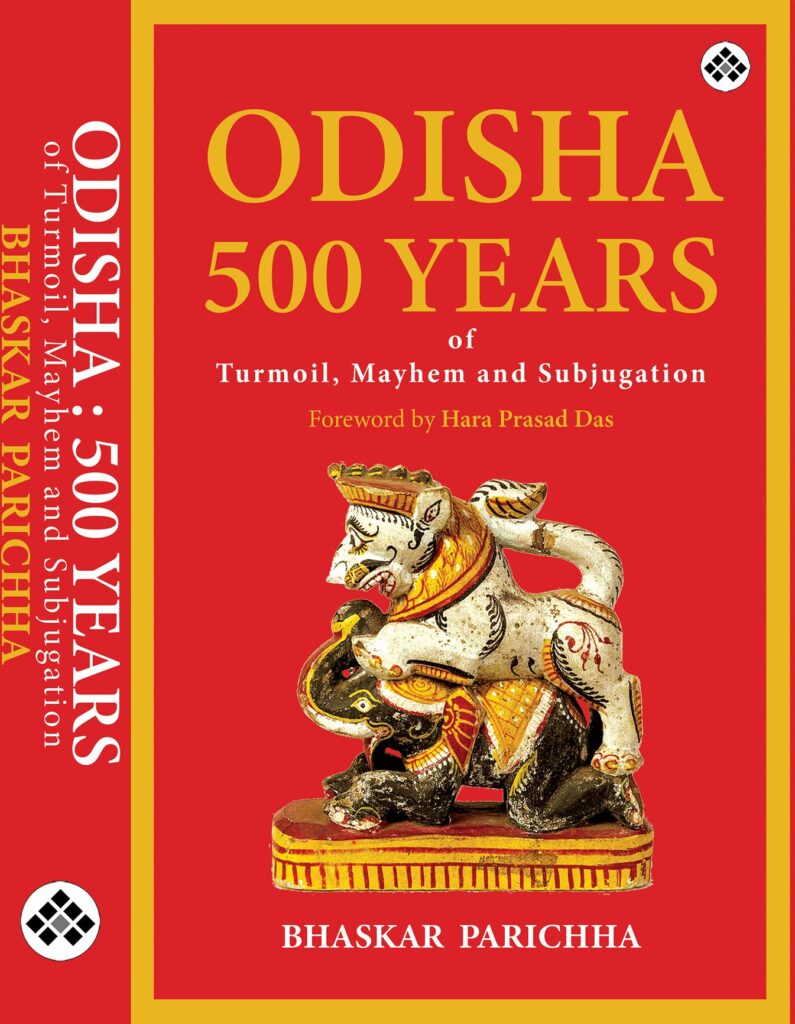
Odisha – 500 Years of Turmoil, Mayhem and Subjugation presents a well-researched study of facts and analysis structured through cognitive processing. It’s an engaging narrative of the state’s intriguing past. For those who believe history reading as only an act of travelling back into the dead past, who accept history as an account of events happened ages before detailed chronologically, Bhaskar Parichha’s book comes as a welcome surprise that provides the readers with a compelling study of Odisha’s rise to the status of an independent state in a chronological order that is not blurred or overlapping or confusing which at times are noticed in texts that narrativize history, in an easily comprehensible, simplistic style.
“This book takes you through a racy summation of historical events and landmarks of historical change that eventually present a fair view of the land and its people,” observes eminent historian Hara Prasad Das in his foreword to the text. It traces the changing socio-cultural landscape, the diverse geo-political aspects, the invasions and infiltrations of foreign powers, the establishment and elimination of regimes that marked Odisha’s struggles, and records the trials, tribulations, and travails it endured before emerging as a separate, independent land.
To avoid confusion in chronology, if at all there might be any, the author at the beginning of the text, offers a distinct timeline in the form of succinct segments, each encompassing a brief mention of significant events during that phase. The corresponding chapters that follow the timeline are a lucid and precise elaboration of those.
The text that begins with the fall of the Eastern Ganga dynasty that reigned over Kalinga, approximately between 1077 CE to 1435 CE and the rise of Gajapati Empire under the Suryavamsa dynasty as a formidable power sets forth to traverse five centuries of upheavals and uprise of Odisha, its navigating of the adversities and hazards with determination and resilience and its evolution as a self-governing territory.
The valiant Kapilendra Deb, the founder of the Gajapati reign, was an empire builder, while his successors, the equally gallant Purushottam Deb and Prataprudra Deb, the southern crusaders, were constantly engaged in conflicts with the Vijaynagar during the 15th and 16th centuries. This was a time marked by intense military actions and battles involving territorial encroachments. Narrativizing the historical details through the use of interesting subtitles like ‘Marriage that Ended a War, The Flickering Flame, Accountant Who became a King’, the text traverses to tell the tale of the Bhoi Dynasty founded by Govind Vidyadhar and the subsequent fall and the establishment of the Chalukya Dynasty.
There follows the episode of misplaced trust and treachery of the vassal chief Ramachandra Bhanja, resulting in the assassination of Mukunda Deb, the Last Lion of Odisha, and the annexation of Odisha to the Bengal Sultanate under the reign of the Afghan Sulaiman Khan Karrani. It was followed by a period of Afghan and Mughal interventions that posed a threat to Odisha, especially to its religious sites, including the famous temple of Lord Jagannath. The era of the Maratha supremacy has a tale of grim tyranny and torment.
The initial chapters sketch the volatile transition in the religio-political scenario, the intriguing interplay of power dynamics and the cunning and calculated shifts in loyalty and liaison that Odisha witnessed during 1435 to 1592, though it was still no smooth sailing when the Naib Nizams of Bengal took over Odisha and even though they played a key role in shaping the religious and local governance of Odisha.
The following chapters explore the phase of the arrival of the European traders, the enforcement of the Portuguese trade regulation, which facilitated their monopoly over Pipli and limited the local traders’ direct access to the international market. The text glides on to reconnoiter and details the consequences of the British annexation of Odisha that marked a decisive turning point as the British East India Company gained control over the region.
‘Odisha’s integration into the company’s administrative framework introduced a new era of governance,’ observes the author, by significantly impacting the political, administrative, economic, and cultural fronts. The promulgation of the policy of Permanent Settlement, as a major agrarian reform, sent a stir of dissatisfaction and resentment among the peasantry, which culminated in a rebellion.
Led by Baxi Jagabadhu Bidyadhar, the Paika community, a peasant militia class of Khurda, Odisha, rose against the loss of their land titles. The impacts of the Rebellion, which was a precursor of the great Sepoy Mutiny of 1857, are discussed in detail in the chapter titled ‘The Rebellions.’ This chapter elucidates the nature and consequences of some other uprisings that preceded and succeeded the Paika Rebellion, which, despite being cruelly suppressed, had a deep and far-flung influence on people’s minds, inspiring a disdain and distrust against the British hegemony.
There was an uprising against the Imperial regime spearheaded by Jayi Rajguru of Khurda just before the Paika rebellion, and following it, there were a series of protests like the Ghumusara Rebellion, the Sambalpur uprising, the Kondh Uprising, and the Peasant and Estate Uprising. These rebellions played a pivotal role in shaping Odisha’s nationalistic spirit and sentiment.
The next Chapter presents a gruesome and sinister account of the mayhem that devastated Odisha during the 1866 famine (the Na-anka Durbhikhya). The impact of the famine was profound and multidimensional. With the death of about two million people due to starvation and the outbreak of cholera and smallpox that followed the famine, and the migration of the others who survived the disaster, severely affected Odisha’s demographic infrastructure. While on the economic front, it caused serious financial hardship, crop failures, and tough agricultural challenges, it also profoundly affected the social structure, causing disruptions and imbalance.
From here, we are led to witness Odisha’s battle for freedom, a two-fold struggle against British Colonial rule and a fight for acquiring a distinct identity. The initial efforts to make Odisha a separate province were led by Madhusudan Das, the founder of the Utkal Sammilani. With the appearance of stalwarts like Gouri Sankar Ray, Gopabandhu Das, and prominent literary figures like Fakir Mohan Senapati on the political scenario, the nationalist movement in Odisha, which was now aligned with the language movement that aimed to establish Odia as an individual language, gained further momentum. Inspired by Mahatma Gandhi’s Dandi March and led by regional figures like Harekrushna Mahtab, Odisha advanced on the road to freedom, progress, and prosperity.
“The era following 1947 in Odisha embodies a tale of unity, strength, and change,’ writes the author. The Odisha of the present time, which evolved out of centuries of ‘turmoil, mayhem and subjugation’ wears now a transformed look, a ‘complex, multifaceted society striking a balance between tradition and modernity, rural and urban progress and the management of natural resources alongside industrial expansion.’
History is supposed to act as the foundational architect of state identity, providing the shared narrative, collective memory, and continuity to know the people and the nation.
Odisha – 500 Years of Turmoil, Mayhem and Subjugation not just discusses the history of our land as an identity giver to it but offers ( validating Henry Glassie’s postulation) a map of the past, drawn from a particular point of view, to be useful to the modern traveler.’
Judged in this perspective, the text instead of being a formula-based registering of facts and figures aiming to serve an academic purpose, turns out to be a fascinating yet honest cartography of the evolution and erasing of regimes and civilizations, of the rise and fall of dynasties, of riots and revolutions spanning a period of about five hundred years in (from 1450 to 1947) Odisha’s chequered past.
A wisely conceived and brilliantly executed tale of the facts in an attractive garb of a narrative, the text is a valuable gift for the new generation of readers, the modern travelers, again in the words of Henry Glassie, in need of a map to know the treacherous roads their forefathers navigated.
(The writer is a former professor of English. Views expressed are personal.)