

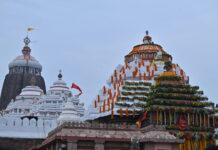























Dr. Satpathy’s book traces the rise of Shakti worship in Ekamra Kshetra, blending tribal, tantric, and temple traditions. A rich study of faith, art, and history.
Bhaskar Parichha

Book Review:
Title: ‘Evolution of Sakti Cult at Ekamra Kshetra’
Author: Dr. Haripada Satpathy
Publisher: BK Classics, Bhubaneswar
Pages: 300/HB
The Shakti cult in Ekamra Kshetra came about from a mix of local tribal goddess worship, pan-Indian Devi traditions, and the rise of tantric practices, especially from the time of the Bhaumakara and Somavamsi dynasties. The roots of Shakti worship in this area go way back, even before written history, blending with pre-Vedic and local goddess traditions that eventually became part of mainstream Hinduism.
As the worship of mother goddesses gained traction, sacred sites called Shakta Pithas emerged, including in Ekamra Kshetra. These places were seen as the seats of Devi, drawing in a wide range of supporters and welcoming participation from all, regardless of caste or gender. Between the 9th and 12th centuries, rulers like the Bhauma-karas (who were based in Jajpur) and Somavamsis added tantric elements and helped build famous temples in Ekamra Kshetra.
Key goddesses that were sculpted and worshipped during this time included Mahisamardini, Saptamatrkas, and Parvati. The rituals and temple practices from this period led to the growth and organization of Shaktism alongside Shaivism and Vaishnavism.
The Lingaraja Temple—a key sacred spot in Ekamra Kshetra—shows the strong link between the Shaiva and Shakta traditions, where Shiva (as Harihara) is honored alongside Shakti. Stories (like the worship by Lord Rama and the Asoka Ashtami festival) highlight how closely tied Shiva and Devi worship are in this area.
In the early days, Tantric rituals, especially those of the Kapalikas and Kaulas, played a big role in temple practices. Eventually, the more radical vamachara (left-hand) tantric rituals were pushed to the sidelines, and the cult started to blend more with mainstream Hindu worship.
As time went on, Shaktism in Ekamra Kshetra became deeply intertwined with both Saivism and Vaishnavism, helping to shape the region’s identity as a hub of religious blending and temple design. The rise of temple dancing girls (devadasis), erotic sculptures, and ritual music showcased this mixed religious culture.
Francesco Brighenti and other researchers have characterized this process as multi-linear, integrating tribal, folk, tantric, and pan-Indian goddess religions as Bhubaneswar evolved into a significant temple city in Hinduism.
Although the overall patterns are evident, there are few direct and highly specific archaeological or textual references to each stage of the cult’s evolution in Ekamra Kshetra; most reconstructions rely on inscriptional evidence, deity iconography, and subsequent regional literature.
‘Evolution of Sakti Cult at Ekamra Kshetra’ by Dr. Haripada Satpathy dives even deeper into this tradition. Dr. Satpathy has worked with both the central and state governments. As a research scholar and Indologist, he has made significant contributions to Odisha’s classic literature, especially in the areas of the Upanishads and Mythology.
Says the book, ‘Shaktism is an all-pervasive religious faith in the Brahmanical order prevailing from the dawn of civilization. It has a far-flung history of its own. Its origin is mysterious and enigmatic. Its multi-linear growth over time revolutionized the multi-faceted religious system of India. All trends of thought from the folk-tribal level to the classical stage got intermingled in Shaktism in the hoary past. This popular faith remains a religio-cultural force in Hindu India. Shakti, a primordial energy of the universe, is virtually reflected in female manifestations, which we perceive in tangible forms with awe and wonder. The emanations of Shakti are numerous, their philosophy is intricate and perplexing, and by nature they are elusive, unknowable, and incomprehensible. To comprehend and understand such a principle and present it consistently is an extremely difficult task.’
The well-presented book addresses the origin, history, and architectural embellishments associated with the Evolution of Shaktism exclusively at Ekamra Kshetra. It has six chapters: Political and Cultural History of Bhubaneswar; the Sakta Religion; the Sakta temples and Shrines; the cult images; the cult of 64 Yoginis; and the decorative motifs of female principles in time art.
According to Dr. Satpathy, the Kalingan School of art and architecture has a rich and continuous cultural and political history that spans over a thousand years, supported by royal patronage and the unwavering backing of the people. So, it was important to focus on the topic ‘Evolution of Shakti Cult at Bhubaneswar’ due to the significant changes in Indian religious beliefs and the presence of diverse indigenous religions and complex cults.
Over time, Bhubaneswar has remarkably managed to preserve its archaeological treasures, thanks in part to its favorable climate. In a significant way, the book explores this subject from multiple perspectives, and there is, according to the author, still much more to deliberate thoroughly and through a comparative analysis.
One major feature of the book is the hundreds of images that back up the text. Without those photos, the book would feel unfinished. With a comprehensive bibliography, “Evolution of Shakti Cut” is a notable contribution to the current literature on the Shakti cult in Odisha.
(The author is a senior journalist and columnist. Views expressed are personal.)