



















A landmark 2025 report has identified Southern Asia, the region including India, as the global hotspot for child malnutrition, bearing the highest burden of deadly wasting and an enormous number of stunted children, signaling a profound crisis for the nation and its neighbors
OdishaPlus Bureau
A damning report from UNICEF, the World Health Organization (WHO), and the World Bank Group has revealed a global stall in the fight against child malnutrition, with Southern Asia at the heart of the crisis. The “Joint Child Malnutrition Estimates (JME) Key findings of the 2025 edition” shows that in 2024, the region had the world’s highest prevalence of wasting and was home to more than half of all children suffering from this life-threatening condition globally.
The report paints a grim picture for the region. While global progress against malnutrition has dangerously faltered, the sheer scale of the problem in Southern Asia is staggering. The futures of tens of millions of children in India and surrounding countries are being jeopardized by inadequate nutrition, which can cause irreversible damage to their physical and cognitive development.
Wasting Crisis: A Regional Emergency
The most acute concern highlighted for Southern Asia is child wasting, where a child is too thin for their height, putting them at immediate risk of death. In 2024, Southern Asia recorded a wasting prevalence of 13.6%, a rate classified as “high” and the worst in the world.
This translates to a catastrophic 24.4 million children under five in the region suffering from wasting. This single figure accounts for more than half of the 42.8 million children affected by wasting globally. The report stresses that these numbers, based on prevalence at a specific point in time, are likely an underestimation of the true annual burden, as they don’t capture the cumulative number of cases that occur throughout the year.
The Immense Burden of Stunting
Alongside the wasting emergency, Southern Asia continues to struggle with an immense burden of stunting, a condition caused by chronic undernutrition that hinders a child’s growth and brain development. The region has a stunting prevalence of 31.4%, a figure classified as “very high”.
In 2024, a staggering 56.4 million children in Southern Asia were stunted. This means nearly two out of every five stunted children in the world live in this region. While this represents a significant reduction from 77.0 million in 2012, the progress is insufficient to meet the 2030 Sustainable Development Goal (SDG) targets, and the remaining burden is enormous.
Globally, the report introduces new sex-disaggregated data, revealing that boys are more likely to be affected by stunting than girls. Across the world, 81.1 million boys were stunted compared to 69.1 million girls in 2024.
A Contrasting Picture on Overweight
In a reflection of the complex “double burden of malnutrition,” where undernutrition and overweight coexist, Southern Asia’s situation with overweight children presents a sharp contrast. The prevalence of overweight among children under five in the region was 3.2% in 2024, which is categorized as “low”. This is significantly lower than the global average of 5.5% and rates in many other parts of the world. However, it still affects 5.7 million children in the region.
This highlights that for Southern Asia, the most urgent and large-scale challenges remain the deep-rooted problems of stunting and wasting.
Global Stagnation and the Path Forward
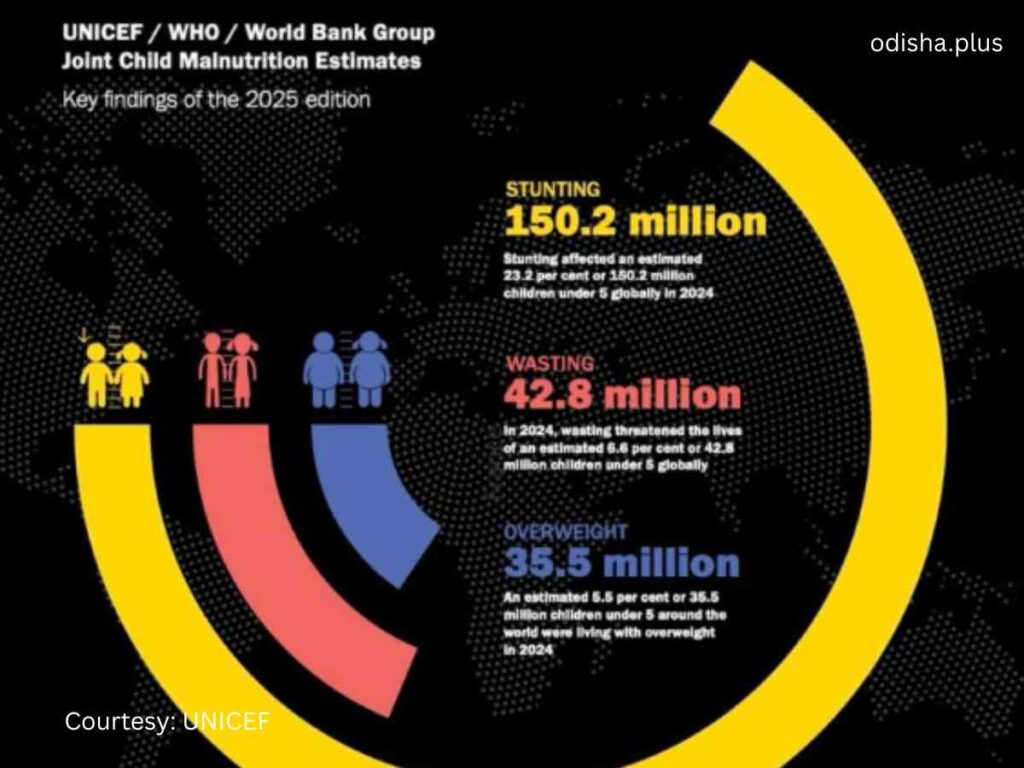
These alarming regional figures are set against a backdrop of faltering global progress. Across the world, 150.2 million children were stunted, 42.8 million were wasted, and 35.5 million were overweight in 2024. The report warns that after two decades of declines, progress on reducing stunting has worryingly halted.
To combat this crisis, the report issues an urgent call for “effective and sustained multisystems efforts driven by robust data”. A critical barrier to effective action, both globally and within regions like Southern Asia, is the lack of regular, high-quality data. The report notes a recent decrease in the availability of monitoring data, which undermines the ability of governments, including India’s, to adequately assess needs, plan programs, and track progress.
Without intensified, country-led efforts and a renewed commitment to regular data collection, the goal of a world without child malnutrition will slip further out of reach. For the millions of vulnerable children in India and across Southern Asia, the cost of inaction is a future of diminished potential and a violation of their fundamental right to grow and thrive.
For more detailed information can visit: https://data.unicef.org/resources/jme