


















Cuttack’s Chandi Medha Durga Puja may enter UNESCO heritage, Amitav Ghosh wins Korea’s Nobel, and Bengaluru hosts Gandhi caricature exhibition
Mrinal Chatterjee

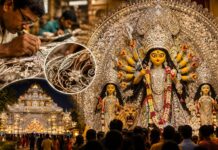
Silver Filigree Tableau of Durga Idols in Cuttack

The history of Durga Puja in Cuttack, the erstwhile capital of Odisha is rooted in the 15th century when the first mass celebration is believed to have begun during the visit of Chaitanya Dev.
With time Durga Puja has become more festive. Number of puja pandals have also increased.
Durga Puja in Cuttack is presently famous for Chandi Medha (Silver Filigree Tableau). As many as 36 plus + Puja Mandaps had Chandi Medha last year. Former administrator, writer and photographer Raja Parija has recently produced a coffee-table book on Durga Puja in Cuttack, focusing on the Chandi Medha. The book has recently been released.
The book may get the much- deserved attention of UNESCO for inclusion of Cuttack’s Durga Puja and Chandi Medha (Silver Filigree Tableau)in the prestigious list of “Intangible Cultural Heritage”.
Parija has produced several coffee table books documenting different areas and aspects of Odisha. His books include, ‘Lighthouses of Odisha’, ‘Royal Heritage of Odisha’, ‘Cuttack- the City of Museums’, ‘Netaji was born here’, ‘Textile Tales from Tribal Odisha’, and ‘Budhist Legacy of Odisha’.
Amitav Ghosh

Amitav Ghosh, wins the 2025 Pak Kyongni Prize, often referred to as Korea’s Nobel Prize in Literature. The award is presented to the “truest writer of our time who has upheld the essential values of literature and made a profound impact on world literary history. Amitav Ghosh is given this award for “expanding the frontiers of postcolonial and ecological literature and for giving voice to subaltern subjects, including nature itself.”
Amitav Ghosh is one of the most celebrated contemporary Indian authors, known for his ability to weave history, culture, and politics into captivating narratives. Born in 1956 in Calcutta (now Kolkata), Ghosh was educated in Delhi, Oxford, and Alexandria, which gave him a cosmopolitan outlook reflected in his writings. His novels often explore themes such as colonialism, migration, climate change, and the interconnectedness of human societies.
Ghosh’s early works, like The Circle of Reason (1986) and The Shadow Lines (1988), established him as a powerful storyteller. The Shadow Lines in particular is celebrated for its nuanced treatment of memory, nationalism, and identity, and it won the Sahitya Akademi Award. His novel In an Antique Land (1992) blends travel writing, history, and anthropology, showing Ghosh’s skill in crossing genres.
One of Ghosh’s most ambitious works is the Ibis Trilogy — Sea of Poppies (2008), River of Smoke (2011), and Flood of Fire (2015). Set in the first half of the 19th century, these novels trace the opium trade, colonial power struggles, and the migration of indentured laborers across the Indian Ocean. Rich in historical detail and linguistic variety, the trilogy is widely regarded as a masterpiece of historical fiction.
Ghosh has also addressed urgent global issues in non-fiction works like The Great Derangement: Climate Change and the Unthinkable (2016), where he examines why literature has failed to grapple with climate change. His later novel Gun Island (2019) continues this focus, blending myth and contemporary ecological concerns.
Exhibition on Gandhi Caricatures

Mahatma Gandhi, undoubtedly was the most photographed, drawn, and written about freedom fighter of our country. Gandhi, Subash Chandra Bose and Bhagat Singh were accorded folk hero status. Posters were printed highlighting their struggle. Poems were written and published. Songs were composed and sung.
Interestingly more cartoons were drawn (and continues to be drawn) with Gandhi than any other leader of the country. From the legendary British era cartoonist David Low to Shankar Pillai, from R.K.Laxman to almost every known cartoonist in the world have drawn cartoons on Gandhi.
Bengaluru based Indian Institute of Cartoonists in collaboration with Egypt Cartoon Platform and Karnataka Gandhi Smarak Nidhi is organising an International Exhibition of Caricatures on Gnandhi from 4 to 31 October at Cartoon Gallery, MG Road Bangalore.
Please visit this exhibition if you can. You’ll be amazed.
(The author is Professor at Indian Institute of Mass Communication, IIMC Dhenkanal. Views expressed are personal.)