







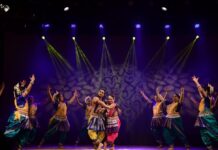











Reela Hota’s book Odissi Dance – Therapeutics, Aesthetics and Metaphysics explores the healing, spiritual, and metaphysical power of Odissi dance
Bhaskar Parichha

Book Name: ‘Odiss Dance – Therapeutics, Aesthetics and Metaphysics’
Author: Reela Hota
Publisher: Prabhat Prakashan
Location: New Delhi
Books discussing India’s classical dances are limited, particularly those that concentrate on Odissi. This specific book is distinguished by its aesthetic appeal. It does not focus on a personal narrative or any historical account. Reela Hota’s book integrates spirituality with art.
Reela is a renowned Odissi dancer, scholar, and yoga practitioner who skillfully combines spirituality with artistry. An artist associated with Sangeet Natak Akademi and Prasar Bharati, she has presented her work at significant international festivals, highlighting Yoga and the Chakra system. As the founder of the Rays of Wisdom Society, she promotes the therapeutic benefits of music and dance, organizing the Annual International Ancient Arts Festival and Symposia. She has been honored with the Gun Gangadhar Pradhan Award Senior Fellowship from the Ministry of Culture, the Atal Bihari Vajpayee Award for Art and Culture, and the Sanatan Nitya Puraskar. Her contributions continue to serve as a link between tradition and contemporary expression, inspiring both artists and scholars.
‘Odiss Dance – Therapeutics, Aesthetics and Metaphysics’ offers an innovative viewpoint on Odissi. It highlights the dance’s therapeutic, psychic, and philosophical aspects, demonstrating how Odissi incorporates various yoga practices and spiritual teachings, acting as a means to healing and liberation.
Says the blurb: ‘This book is a groundbreaking exploration of Odissi, one of India’s oldest classical dance forms, dating back to at least the second century BCE. This book presents an entirely different perspective, emphasising the dance’s therapeutic, spiritual, and metaphysical dimensions. It explains how Odissi embodies all forms of yoga and spiritual principles, serving as a pathway to healing and ultimate liberation (moksha).
In the Preface, Reela writes, ‘As time passed, I began to realize that many of the spiritual principles I had been practicing were intricately woven into the fabric of Odissi itself. To delve deeper into this connection, I applied for and received the Senior Fellowship from the Ministry of Culture. My research revealed that the core principles of Odissi resonate with spiritual traditions from various cultures worldwide, indicating a universal truth at the heart of this sacred dance. This journey of exploration led to the development of my current book.’
Reela is correct in her assertion that scientific research on Odissi dance is scarce and that ancient texts concerning dance seldom elucidate the rationale behind its structure. To address this deficiency, she broadened her research to encompass healing systems such as Yoga.
This wide-ranging perspective enables the book to provide convincing evidence of Odissi as a sophisticated and evolved healing practice.
Her analysis highlights the internal effects of Odissi on the dancer—specifically, how the postures, movements, and music influence the performer’s inner state—rather than focusing on its external effects on the audience.
The book provides a comprehensive exploration of Odissi and its intricate elements. It consists of eight chapters, including Introduction, The Healing Postures, The Mudras, Healing Vibrations, Odissi as a Dynamic Form of Meditation, The Healing Emotion of Transcendence, and The Sacred Spaces of Odissi. Reela has conducted extensive research, and the book adopts an interdisciplinary approach. With substantial illustrations, it serves as a practical resource, allowing readers to grasp the subtleties of the dance.
Featuring a foreword by Arvind Sharma from McGill University, a distinctive feature of this book is its cross-cultural perspective, connecting Odissi with other global art forms that embody metaphysical concepts. The author employs scientific research to demonstrate how these art forms promote inner transformation, emphasizing the internal effects of Odissi on the dancer’s psyche, energy, and consciousness, rather than merely focusing on external performance.
The book is dedicated to her late father, PC Hota, who served as Secretary to the Government of India and made significant contributions to the training and personnel department.
This book is an invaluable resource for Odissi dancers, scholars, and art enthusiasts.
(The author is a senior journalist and columnist. Views expressed are personal.)