




















Mrinal Chatterjee, Window Seat, Lodhi Garden, Majrooh Sultanpuri, stray dogs, Hindi cinema, monsoon evening, dog debate, Indian culture, Delhi
Mrinal Chatterjee

A Monsoon Evening in Lodhi Garden
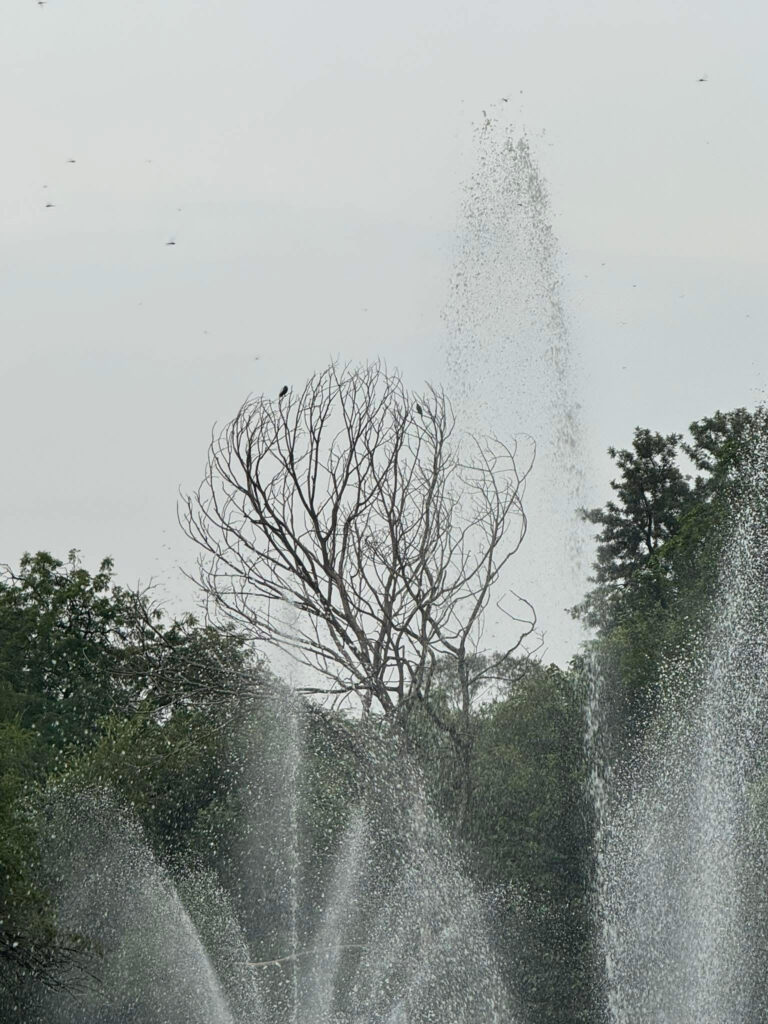
I had been to Delhi’s Lodhi Garden several times and liked the place. It is full of trees and monuments. Recently I read a piece on dead trees in Lodhi Garden, which look like monuments and adds to the beauty of the Park. I could see that that tree. Excerpts:
While it had died a long time ago, it had continued to stand, giving the park a haunting beauty. Park visitors would sit on the bench under it. Some weeks ago, the tree fell on its own accord. Days later, a spindly stalk was seen standing on the exact spot where the tree would stand. It was probably hoped that the new plant might one day grow into a tree.
It is a signal to shift our affection to another dead tree. This one is equally beautiful. It too is in Lodhi Garden. The tree is best seen from the vantage point of Athpula stone bridge, the only Akbar-era edifice in the city. The softly arched bridge spans over the park’s duck pond. The west-side parapet overlooks the larger length of the pond, whose both sides are lined with a dense collection of trees. And far in the distance stands the leafless tree. Its brown visage is severe, standing out starkly among the green verdure of the neighbouring trees. The tree is comprised of dozens of leafless branches standing upright. The branches look like twigs with sharp prickly ends poking up into the empty air.
The bare tree is reached. It stands by the pond, facing the ramparts of Sikander Lodhi’s tomb. A heart-shaped object is stuck on the trunk—must be a wild mushroom. This moment, the tree’s austere branches are claimed by a single bird. It is motionless. The scene evokes a haiku by Japanese poet Bashō:
“On a withered branch
a crow has come to rest
autumn evening”
Of course, here in Lodhi Garden, it is a monsoon evening.
Quarter of a Century sans Majrooh Sultanpuri
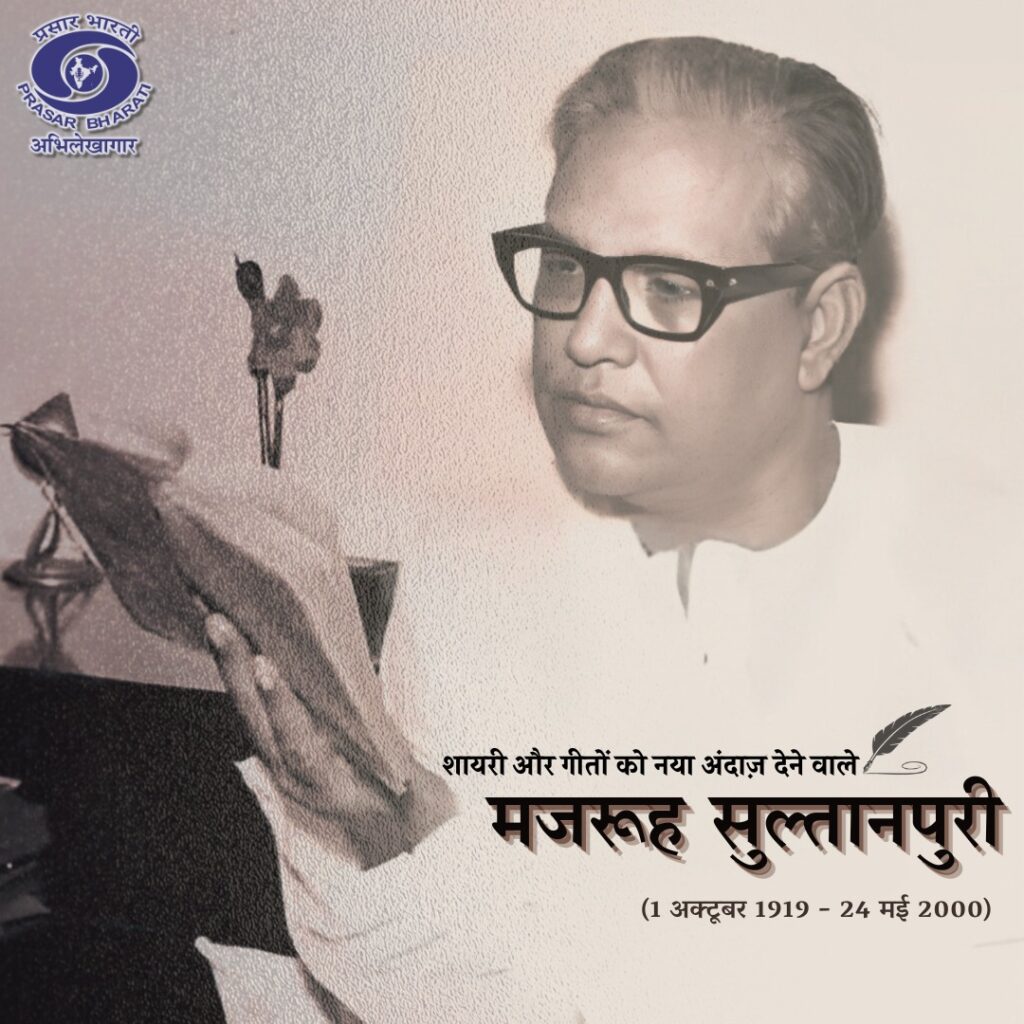
It has been quarter of a century since Majrooh Sultanpuri, the evergreen voice of Hindi cinema, one of the most celebrated lyricists of Hindi cinema, whose poetic brilliance defined the soundtrack of several generations left us.
Born Asrar ul Hasan Khan in Sultanpur, Uttar Pradesh, on 1 October 1919, he began his literary career as an Urdu poet, winning recognition at mushairas with his eloquent ghazals. His entry into films came in the 1940s, when music director Naushad introduced him to the world of Bombay cinema. From then on, Majrooh’s pen created magic that continues to resonate.
What set Majrooh apart was his versatility. He could pen soulful ghazals, playful romantic ditties, philosophical musings, and youth anthems with equal ease. His lyrics carried an innate poetic quality while remaining accessible to the common listener. Songs like “Chhodo kal ki baatein” captured the spirit of a new India, while “Chura liya hai tumne jo dil ko” mirrored youthful romance with unmatched charm. Across five decades, he worked with the greatest composers, from Naushad and S. D. Burman to O. P. Nayyar, R. D. Burman, and Anand–Milind, shaping the soundscape of Hindi cinema.
Majrooh’s contribution was not limited to romantic songs alone. His writings often reflected progressive ideals, a spirit he carried from his association with the Progressive Writers’ Movement. He even endured imprisonment in the early years of independence for his outspoken verses.
With more than 3,500 film songs to his credit, Majrooh Sultanpuri carved a permanent niche in the hearts of listeners. In 1993, he was honored with the Dadasaheb Phalke Award, the highest recognition in Indian cinema, becoming the first lyricist to receive it.
He died on 24 May 2000.
Majrooh was more than a songwriter; he was a cultural voice who gave Hindi cinema its poetic soul. His words continue to live on, timeless and evergreen, echoing in every melody that carries his lyrical touch.
The Dog Story

Dogs, especially stray dogs have triggered a heated debate following the court verdict ordering their removal from public space. The country seems to have been divided in two groups, one supporting the court verdict and the other opposing it. I sit on the fence.
I do not particularly like stray dogs. Twice they have managed to make me fall down from my two wheeler. Many times they have stalked me- and God was I scared. Even then I cannot fully support the idea of banishing them from our neighbourhood for they have been a part of our public space for thousands of years.
It was the dog that came before kittens, chickens, goats, cows, or crops. Humans formed an unlikely partnership with the grey wolves, the common ancestor of all the domestic dogs (Canis lupus familiaris). Over time, these wolves underwent striking physical and behavioural changes: their skull, teeth, and paws shrank, their body temperature changed, their ears flopped, and they acquired a more docile temperament. They learned to read the complex expressions that ripple across human faces and master the art of the ‘puppy eyes’ to grab our attention.
Scientists suggest that somewhere between 40,000 and 15,000 years ago, wolves (Canis lupus) began edging closer to human camps in search of animal scraps and other edible discards. Humans, in turn, recognized the usefulness of wolves as hunting partners and then later as guards. At this stage, companionship was never on the minds of wolves when they began to tag along; they were merely sharing the table (and the kill). Biologists call it ‘commensalism,’ literally translated to eating at the same table.
Dogs helped human beings settle down. Dogs were the first of the animals to be our friends. How can we just banish them from our neighbourhood!
(The author is Professor at Indian Institute of Mass Communication, IIMC Dhenkanal. Views expressed are personal.)