












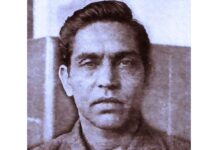







Remembering singer Zubeen Garg, whose music, compassion, and fearless voice united Assam and inspired India with love and human solidarity
Dr. Goutam Saha

It is not a great time for the people of our nation, divided by politics, religion, caste, class, and language. Social media is flooded with content full of hatred. Around us, there is a dire shortage of ideal individuals—those who could inspire the people of the country, unite them in harmony, and lead them toward progress. In such a restless and dim period came the death of singer Zubeen Garg, and after his passing, various aspects of his life unfolded across social media.
What we witnessed left us astonished: the eastern Indian state Assam, historically divided by politics of hatred and separation, came together in a wave of love and solidarity to mourn him. We witnessed that “unity in diversity” is not a mere slogan; it can indeed be a living reality. What was that magic wand that could truly unite people and inspire them toward goodness?
From Zubeen Garg’s 52-year-long life, perhaps we as a nation—our intellectuals, artists, writers, sportspeople, and many of us from different corners of lives—can learn something that will bind our society together, moving it away from hatred and division toward a greater humanity, toward human solidarity. The purpose of this essay is to explore these five magical wands from the late artist’s remarkable life.
A 19-year-old B.Sc. student once told his college principal, “I’ll leave college and devote myself to music—I’ll become a great artist.” The very next year, after leaving college, he mesmerized both the young and the old of Assam with his two music albums, Anamika and Gaane Ki Aane. That very year, he returned to his college as a special guest—Zubeen’s story sounds like a fairy tale. Not just a singer, Zubeen could play around 12 musical instruments and was versatile in every genre. Around that time, Bengal saw the rise of a new wave of cinema, with new heroes and a need for new voices. Having studied Bengali in school and grown up in an Assamese-Bengali colony, Zubeen fulfilled that need effortlessly, gifting Bengal countless hit songs.
Bollywood soon called him, and one of his earliest Hindi songs, “Ya Ali” from Gangster, won him the Global Indian Film Award for best male playback singer. With one hit after another, he became Bollywood’s ‘Humming King’. Not just in Hindi, Bengali, or Assamese—Zubeen sang in over 40 languages, with a total of 38,000 songs. After Bhupen Hazarika, the entire Northeast found in Zubeen its new, successful cultural icon. Yet this icon was unlike any other. The professional life and traffic chaos of Mumbai suffocated him; connected emotionally to the rivers, forests, open skies, and people of Assam, Zubeen returned to his homeland.
The people of Assam were moved to see that while most artists chase Bollywood success with single-minded focus, Zubeen chose to return to his own land. Through countless Assamese songs, compositions, acting, direction, and film production, he became an inseparable part of Assamese culture. His nationwide fame brought Assamese music and cinema new recognition.
With big-budget productions like Mission China and Kanchanjunga, Zubeen took immense financial risks to promote Assamese cinema. He composed the music for filmmaker Rima Bora’s documentary Sound of Silence without charging any fee—a work that earned him a National Award and gave Rima national recognition. Zubeen constantly uplifted new artists, often encouraging them and backing them to get various awards. When asked why he left Bollywood, he said simply: “A king never leaves his kingdom.”
Whenever Assam faced floods or natural disasters, Zubeen reached out with his charitable organization, Kalaguru Artists Foundation, to provide relief. Jubin offered his very big house for treating COVID-19 patients during the pandemic. He also organized cultural events and football matches to raise funds for the victims. He donated money and distributed books to flood-affected schools, organized sports events to promote youth athletics, and helped athletes like famous Olympian boxer Shiva Thapa and sprinter Hima Das during their formative years.
Zubeen and his wife, Garima Saikia Garg had no children of their own, but they supported 15 underprivileged boys and girls, taking full responsibility for their education, upbringing, and even marriages. Many of these children were rescued by Zubeen himself from abusive families; he fought legal battles to gain custody of them.
His love for animals was extraordinary. Apart from his four pet dogs, he rescued numerous sick and abandoned animals from across the state and arranged for their treatment. He remained deeply associated with Kaziranga’s wildlife rescue and rehabilitation programs till his last days. Despite being a celebrity, Zubeen always mingled freely with ordinary people—rickshaw pullers, street vendors, and the homeless. He would eat and spend time with them, often giving money generously. For the common people of Assam, Zubeen was not a distant star but one of their own—a companion in joy and sorrow.
Zubeen frequently spoke out against both the former Congress and the present BJP governments on local Assamese issues and ethnic identity. His songs and films often became the voice of Assamese culture and political protest. During the protests against the Citizenship Amendment Act (CAA), Zubeen Garg emerged as one of Assam’s strongest secular voices.
At the same time, he openly opposed the militant United Liberation Front of Assam (ULFA). When ULFA ordered that only Assamese songs be performed during Bihu, Zubeen defied it, singing in Bengali and Hindi, declaring: “The sky of culture cannot be confined.” Yet, he never personally attacked any political leader, nor did he ever join any political party. He fearlessly criticized policies and politics, not individuals. As a result, upon his death, leaders across the spectrum—including Chief Minister Himanta Biswa Sarma, members of the BJP, the Congress, and even ULFA—expressed deep condolences. Representatives from all political parties joined his funeral procession.
Zubeen was candid and fearless about his beliefs. He often said publicly: “I have no religion, no caste, no God. I am free, I am Kanchanjungha.”As proof of renouncing Brahminical orthodoxy, he would openly show his sacred-threadless body. Yet, he never insulted any religion; rather, he repeatedly asserted that social service is the highest form of religion, and he proved it through his actions. All his life, he stood against religious polarization. He sang zikir songs for Assamese Muslims, gospel songs for Christians, and numerous devotional songs for Hindus. Through these, he soothed the hearts of people of all faiths—Hindu, Muslim, Christian, and tribal alike.
After his death, Muslim students sang his songs inside mosques, imams recited the Quran in his memory, and Christians gathered in churches across Dibrugarh and Assam to hold memorial prayers. As per his last wish, his mortal remains were immersed in the Brahmaputra River. The child of Kanchanjungha thus merged with Assam’s greatest river—its waters, sands, and stones. The millions of Assamese, forgetting their divisions, sang together his favourite song—“Mayabini Ratir.”
Zubeen once said he disliked the funerals of celebrity Rajesh Khanna and Lata Mangeshkar in Mumbai as a very limited number of people joined. He had declared,“ When Zubeen Garg dies, Assam will cry for seven days. “And the people of Assam kept their word. His funeral became the fourth-largest funeral procession in the world, as recognized by the Limca Book of Records. Shops, markets, and celebrations across the state shut down spontaneously; tears flowed from hearts heavy with grief.
And yet, amidst that sorrow, we witnessed a strange light of hope—proof that even in a land divided by religion, caste, language, and politics, unity is possible. If each of us could live by these five magic wands in our own lives, even though small acts of kindness, we could weave together our villages, towns, states, and our nation in the thread of love. This Diwali, let the light of hope and unity shine in every home—that would be the greatest tribute to Zubeen Garg.
(The author is an Associate Professor at the National Institute of Fashion Technology, Bhubaneswar. Views expressed are personal.)