





















NDA scores a landslide win in Bihar, BJP and JD(U) rise, RJD suffers major setback. The result reshapes alliances and signals a new phase in Indian politics
OdishaPlus Bureau
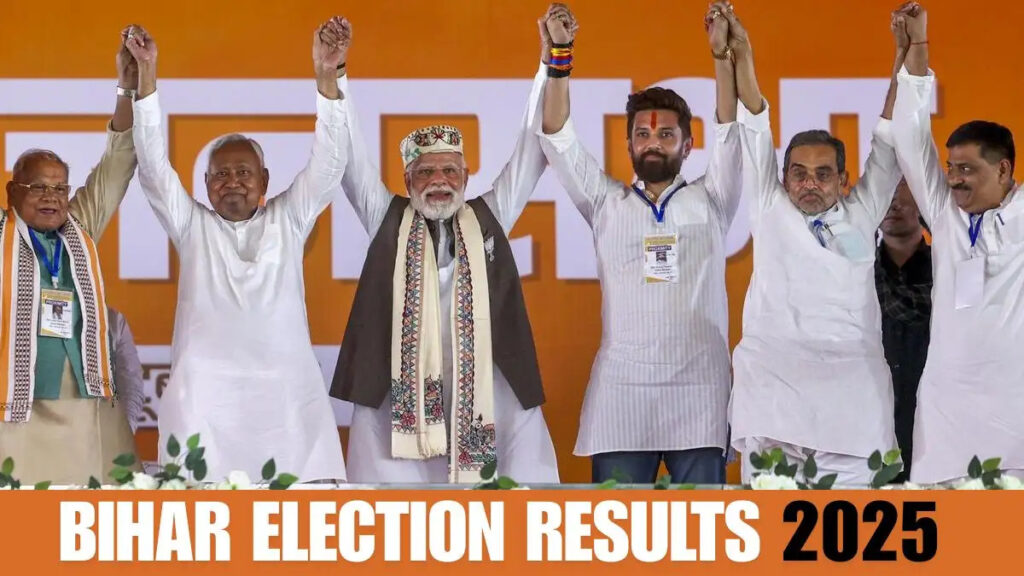
The biggest electoral battle of the year in India has ended not with a cliffhanger but with a rout. What was expected to be a hard-fought contest in Bihar has turned into a stunningly one-sided verdict in favour of the National Democratic Alliance (NDA). The scale of the victory mirrors the BJP-led Mahayuti’s sweeping decimation of the Maha Vikas Aghadi in Maharashtra last year, underscoring once again the BJP’s ability to dictate the political narrative and convert organisational muscle into decisive electoral outcomes.
In Bihar, the BJP has emerged as the single largest party, consolidating its influence in a politically complex state where it has long played the role of kingmaker but has yet to anoint its own chief minister. Equally significant is the performance of the JD(U) under Nitish Kumar. Bihar’s longest-serving chief minister, often written off as a leader past his prime, has staged a dramatic resurgence. Finishing a close second to the BJP, Nitish has silenced his detractors — many of whom were quick to declare the end of his political relevance.
The Rashtriya Janata Dal (RJD), once the dominant force in Bihar’s caste-driven political landscape and the party with the highest number of seats in the 2020 Assembly elections, has suffered a humiliating setback. Reduced to a distant third, the RJD now faces an existential moment. Lalu Prasad Yadav’s charisma, Tejashwi Yadav’s energetic campaign, and the Mahagathbandhan’s promises of jobs and social justice failed to resonate with voters in the face of the NDA’s superior electoral machinery and carefully crafted coalition arithmetic.
The verdict has immediate consequences and longer-term implications for Bihar’s political stability. The sheer imbalance in the outcome means the BJP and JD(U) remain mutually dependent partners — for now. Nitish Kumar, infamous for abruptly switching alliances and earning the moniker ‘Paltu Ram’, no longer has the luxury of political zigzags. But there is a flip side: the BJP is acutely aware that it needs the JD(U) at the Centre, especially with the party falling short of a Lok Sabha majority. Any attempt to unseat Nitish or engineer an internal rebellion could risk destabilising the NDA government nationally.
Yet, political instinct cannot be wished away. The BJP has repeatedly demonstrated a long-term appetite for expansion and control, and Bihar remains one of the few large Hindi-heartland states where it has never installed its own chief minister. Chirag Paswan’s presence, too, complicates the picture. His Lok Janshakti Party (Ram Vilas) has often played the role of disruptor, and he would not hesitate to exploit even the smallest fissure within the alliance. The Maharashtra precedent — where the BJP strategically elevated Eknath Shinde to displace a former ally — looms large, and it is unlikely that the party will indefinitely suppress its ambition to dominate Bihar’s political theatre.
For the Opposition, the Bihar result is nothing short of a body blow. The Mahagathbandhan stands fractured, its messaging muddled, and its organisational coherence questioned. The defeat is particularly embarrassing for Prashant Kishor, who had positioned himself as an architect of political renewal in Bihar. His vision of a “new dawn” — driven by grassroots mobilisation and citizen-centric politics — has been pushed further into the distance.
The implications extend well beyond Bihar. The INDIA bloc, already grappling with internal contradictions and the lack of a unified narrative, must now prepare for a high-stakes electoral cycle next year. West Bengal, Kerala and Tamil Nadu — three of the few remaining bastions of Opposition power — will face Assembly elections, each with its own political complexities.
The BJP, emboldened by consecutive victories and hungry for new territory, will deploy its full force to penetrate these states. Bengal will see a renewed attempt to weaken the Trinamool Congress; Kerala will likely witness an aggressive push to disrupt the Left-Congress bipolarity; and Tamil Nadu will face the BJP’s intensified efforts to fracture Dravidian politics.
The Bihar verdict is therefore more than a regional outcome. It is a bellwether for the shifting balance of power in Indian politics. For the NDA, it reinforces momentum and unity at a time when national stability hinges on coalition cohesion. For the Opposition, it is an urgent reminder that electoral success requires more than alliances — it demands clarity, credibility, and a compelling alternative vision.
As the dust settles, one conclusion stands out starkly: the battle lines for the next phase of Indian politics have already been drawn, and the road ahead will test the resilience of both alliances in ways that Bihar’s voters may only have begun to reveal.