


















A look back at how Doordarshan began its journey in 1959 and grew into India’s national broadcaster, shaping media, culture, and ethical journalism
Sheila Chaman
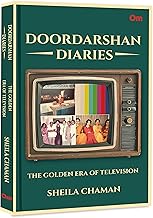
Book Title: Doordarshan Diaries
Author: Sheila Chaman
Publisher: Om Books International
Location: New Delhi, India
The history of the rise of India’s largest national broadcaster has been nothing short of phenomenal.
Under the aegis of Prasar Bharati, the autonomous body funded by the Ministry of Information and Broadcasting, Doordarshan stands as one of the timeless sentinels, serving as a key medium for information, education, and entertainment.
Many people have been instrumental in its rise in significant ways. I, too, have been a part of Doordarshan for three decades in various capacities. I took upon myself the humongous task of locating and seeking out some of the dedicated people who had worked diligently and tirelessly to take DD to its heights of glory. It is true that I had the good fortune of having worked with some of them, experiencing the exhilarating moments of achievement as and when some new dimensions were explored and new techniques added to the medium. In this book, a few others and I have penned some behind-the-scenes stories and hitherto unknown facts to regale the readers, especially those who have remained faithful viewers of DD. The process indeed felt like ripping open a pillow full of feathers and scattering them in the breeze, and then trying to collect and put them all back again. Doordarshan began its humble journey on 15 September 1959, quietly making its way into Indian households. Over the years, it has grown into a dynamic bouquet of 24/7 channels-DD News, DD Sports, DD Bharti, DD Urdu, DD Kisan, and DD India reflecting a unique facet of the nation’s vibrant tapestry. In the spirit of connection and outreach, Doordarshan launched DD India on 14 March 1995 as DD International, extending its voice far beyond Indian shores. More than a television channel, DD India emerged as a cultural lifeline, keeping the Indian diaspora connected to their roots while simultaneously presenting a confident, contemporary India to a global audience.
My own reflections on Doordarshan, necessarily and inevitably, mirror my journey, for they bespeak Doordarshan’s role in my growth as a visual media person. To me, DD indeed symbolizes a banyan tree, nurturing many a talent and many an eager entrant, sometimes with admonition, sometimes with appreciation and encouragement. I, too, entered DD as a fledgling and soon grew wings under its care, and learnt to soar high. Most importantly, DD gave me an invaluable education in abiding by the principles of ethical journalism and impactful presentation. It was an on-the-job learning experience, and I evolved along with the medium. It was also the wide exposure that threw open numerous avenues and opportunities, giving us, DD presenters, “celebrity status” and much adulation from our viewers.
In January 1959, an electronics exhibition in Delhi showcased closed-circuit cameras brought by Philips India, captivating visitors, including Prime Minister Jawaharlal Nehru. Enthralled by this magic, the city buzzed with excitement. After the exhibition, Philips donated the equipment to the Indian government, laying the foundation for television in India.
The same year, a modest studio had been set up within All India Radio (AIR) and experimentally transformed into a TV kendra ar Akashvani Bhavan in New Delhi. Equipped with a 500kW transmitter, it had the capacity to broadcast within a 25-km radius around Delhi. Engineers at AIR studied the manuals of the equipment donated by Philips, assembled the cameras, and began experimental broadcasts. Radio officials, engineers, and renowned figures collaborated to shape early television programming. They proved that despite challenges and minimal resources, Doordarshan could create impactful content.
The first president of India, Dr Rajendra Prasad, launched Doordarshan (then known by the name “Television India’) as a pilot project at the AIR studio in New Delhi on 15 September 1959. It initially broadcast only a single black- and-white transmission for a few hours a day, focusing on educational and developmental content, such as agriculture, family planning, and literacy.
In the early days of no cable services, Doordarshan became the only channel as a mode of entertainment, with programmes aired only between 6 p.m. and 10 p.m. Its early years were foundational in shaping the national media landscape in India. It brought television to the masses, establishing it as a central medium for communication, also connecting urban and rural India in the process.
Though its content was often government-oriented and educational in nature, it served as the primary form of entertainment and information for the majority of Indians for several decades.
Throughout the 1960s, Doordarshan’s operations were still limited to the national capital, and its reach was confined to only a few thousand viewers. Television was a luxury, and sets were few in number. But the government was now growing keen on tapping this resource as an effective tool for social progress and national integration.
Doordarshan started its daily transmission in 1965 while it was part of AIR, with a two-minute headline bulletin in Hindi, prepared at AIR, as there was no newsroom in DD back then. This was read by Jagdish Sarin. Later, in 1967, a full-fledged ten-minute Hindi news bulletin was read by the first known TV Hindi newsreader, Pratima Puri. At a time when women were still bound by stereotypical and patriarchal restrictions, she was the first woman to occupy an influential space in the Indian newsroom.
(Excerpts from the book ‘Doordarshan Diaries’ by Sheila Chaman; published by Om Books International/New Delhi)
Great book.