









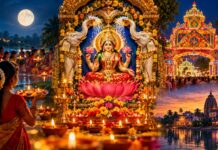











Vande Mataram’s 150-year legacy reflects India’s unity, history and politics, especially its role in Bengal’s cultural and electoral landscape
Bhaskar Parichha

Prime Minister Narendra Modi’s decision to open the Lok Sabha debate on Vande Mataram on the occasion of its 150th anniversary is loaded with symbolism and political messaging. Bankim Chandra Chatterjee’s composition is inseparable from India’s anti-colonial imagination. It stirred Bengal’s early revolutionaries, nurtured the Swadeshi spirit, and later became part of the national canon. Few cultural artefacts carry such historic weight. Recognising its legacy in Parliament is, on the surface, a fitting tribute.
Yet, anniversaries in Indian politics rarely exist in isolation. They unfold within larger political calculations, and this moment is no exception. With West Bengal preparing for a fiercely contested Assembly election, the Centre’s renewed emphasis on Vande Mataram inevitably intersects with electoral strategy.
Modi’s speech projected the song as a symbol of unity and civilisational pride. But layered beneath the rhetoric were familiar political undertones—criticisms of the Congress’s past positions, renewed references to historical controversies surrounding the song, and subtle reminders of ideological disagreements that date back decades. By invoking these debates on such a commemorative platform, the PM appeared to be engaging in a dual exercise: honouring a national song, while simultaneously sharpening political divides.
In West Bengal, this symbolism acquires an even sharper edge. The state holds a unique relationship with Vande Mataram, not merely as a composition but as part of its cultural and literary heritage. Bengal’s political identity has long been intertwined with cultural pride—from the Bengal Renaissance to the literary nationalism of the late 19th and early 20th centuries.
Today, however, this cultural identity is a contested space. For the BJP, asserting ownership over icons born in Bengal is a way of gaining political foothold. For the Trinamool Congress, asserting Bengali cultural pride is key to resisting the BJP’s advances. In this terrain, Vande Mataram becomes more than a song—it becomes a political instrument.
Mamata Banerjee’s swift endorsement of the parliamentary discussion reflects this reality. She has no intention of allowing the BJP to monopolise the symbolism of Vande Mataram. Her response underscores a deeper truth: cultural icons in Bengal are never politically neutral, and both sides recognise their electoral resonance.
Yet, in this competition, what gets overshadowed are the lived concerns of Bengal’s citizens. The state grapples with serious economic challenges—rising unemployment, outward migration of skilled youth, sluggish industrial investment, and recurrent political violence. These issues demand sustained policy attention, not symbolic contests over cultural heritage.
The broader concern is the Modi government’s growing pattern of converting cultural markers into political battlegrounds. Whether it is renaming cities, reframing historical narratives, or foregrounding selective icons, the cultural realm is increasingly being used to reinforce ideological divisions.
The debate on Vande Mataram could have been an opportunity to engage with the song’s layered history: its role in anti-colonial mobilisation, its controversial exclusion of certain perspectives, and its evolution into a national symbol. A mature democracy should be able to celebrate such heritage while still acknowledging the plural, composite nature of Indian nationalism.
Instead, the conversation risks being flattened into a binary—between those who embrace the song unquestioningly and those who are portrayed as opposing it? This polarisation serves political ends, particularly in an election season, but it does little to deepen our understanding of the past or strengthen social cohesion.
As Vande Mataram completes 150 years, the moment calls for reflection, not reduction. The song’s power lies not merely in its historical significance but in its ability to evoke a sense of collective belonging. That spirit is undermined when cultural icons are used to score political points. India deserves commemorations that rise above electoral compulsions—moments where history is invoked not as a weapon but as a bridge.
If national symbols are continually reinterpreted through partisan lenses, they risk losing their unifying force. The responsibility lies with political leadership across parties to resist the temptation of turning every cultural milestone into a campaign moment. History must illuminate, not divide; it must expand the nation’s imagination, not constrict it within the narrow boundaries of electoral arithmetic.
A 150-year-old song that once inspired unity in the face of colonial rule should continue to unite India today. That requires political restraint and a willingness to engage with history in all its complexity—something that remains in short supply in the churn of contemporary politics.
The author is a senior journalist and columnist. Views expressed are personal.)
One of the finest comments on the iconic song vande mataram. Reductionist political interpretation of any cultural icon plunders the lustre out of it , that the political overzealots cutting across parties should understand. They are doing more harm to the cultural icon than embellishing it , they must be thinking of doing.