



















Discover Rabindra Mandap in Bhubaneswar, Odisha’s iconic cultural hub for Odissi dance, folk arts, music, and theatre—where tradition meets modern creativity
Bhaskar Parichha

In the heart of Odisha’s capital, Bhubaneswar — a city where ancient temples whisper stories of millennia — stands an auditorium whose narrative is rooted not in stone carvings but in the lives, voices, dances, and rhythms of its people. Rabindra Mandap, named after the towering literary and cultural giant Rabindranath Tagore, may lack the antique heritage of Bhubaneswar’s sacred monuments, yet it has become a modern temple of culture in its own right.
New Capital’s Aspirations
Bhubaneswar was designed as a planned capital in the aftermath of Indian independence, along with Chandigarh. Its urban blueprint drew the city into a new role — not merely as an administrative hub, but as a center for culture and learning. In that era of optimism in the 1960s, Rabindra Mandap arose, symbolizing a commitment to modernity infused with artistic depth. By invoking Tagore’s name — a poet who personified literary humanity and cultural pluralism — the venue was envisioned as an inclusive space where artistic excellence could flourish across languages, classical forms, and folk traditions.
This naming was itself a statement: Odisha’s cultural scene would not be insular; it would engage with India’s broader artistic ethos, echoing Tagore’s vision of cross-cultural dialogue and humanistic arts.
Stage and Architecture
Though modern in form rather than ancient in lineage, Rabindra Mandap’s architecture is purposeful — designed to accommodate large audiences comfortably and support the technical demands of varied performances. With seating for roughly 800–1,000 patrons and acoustics tailored to dance, music, and drama, it stands as one of the city’s principal performance venues.
Through the decades, the auditorium has witnessed incremental improvements — from major renovation in 2008 to upgrades in sound and lighting equipment in the 2010s — reflecting an ongoing effort to keep the space relevant in the digital age.
Artistic Landscape
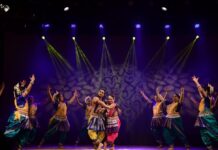
The programming at Rabindra Mandap unfolds like a living map of India’s diverse artistic landscape. At its core are Odissi and other Indian classical dance traditions, with annual and international festivals that celebrate Odissi as one of the country’s most ancient classical forms, inseparable from Odisha’s spiritual and performative heritage.
Alongside these refined classical expressions, the Mandap has consistently given space to folk and tribal traditions, most notably Mayurbhanj Chhau, the powerful martial dance form of northern Odisha, allowing it to command a prestigious urban stage and reach wider audiences. Music, too, finds a deep and inclusive presence here: the long-running SAMARPAN festival has brought Sufi and pan-Indian devotional traditions to Bhubaneswar, reinforcing the Mandap’s role as a bridge between regional cultures and trans-regional spiritual expressions.
The auditorium is also a hub for stage plays. Numerous are the plays and performances have taken place over the past sixty years. Together, these strands create a vibrant confluence where classical rigor, folk vitality, devotional depth, and literary sensitivity coexist, defining Rabindra Mandap as a truly plural cultural space. This remarkable range — from tribal forms to pan-Indian devotional music, from classical nuances to contemporary interpretations — has cemented Rabindra Mandap’s identity as a cultural crossroads.
A Civic Space
Rabindra Mandap is more than a venue; it has become part of Bhubaneswar’s public life — a place where stories are told, memories are made, and cultural identity is celebrated. For artists, performing here is a milestone; for audiences, an opportunity to witness excellence that transcends language barriers. Conversations in the lobby, debates in the atrium, and the clapping of an appreciative crowd all contribute to a living cultural memory that is distinctly Odia yet proudly inclusive.
However, like all institutions, it is not without challenges. Calls for improved infrastructure and maintenance have surfaced over time, reminding us that cultural spaces require continuous civic investment to remain vibrant and accessible.
Looking Ahead
As Bhubaneswar continues to grow as a smart city and a cultural capital, Rabindra Mandap’s role is evolving. Younger audiences bring new expectations — multimedia shows, experimental art, community collaborations — and the Mandap must adapt while honoring its legacy of artistic excellence.
The auditorium stands not as a relic, but as a living cultural organism — one that simultaneously honors tradition and embraces innovation. In the rhythm of a dancer’s footfall, the cadence of a classical raga, or the lyrical cadence of Tagore’s verse, Rabindra Mandap reflects the continuity of India’s cultural soul in a rapidly changing world.
(The author is a senior journalist and columnist. Views expressed are personal.)
Rabindra Mandap is truly a spectacular cultural space in entire Odisha.
I have watched plays here and enjoyed the ambience very much.