





















Discover insights from Suresh Chandra Sarangi on modern democratic challenges, post-truth media, crony capitalism, and the vital path to electoral accountability
Suresh Chandra Sarangi
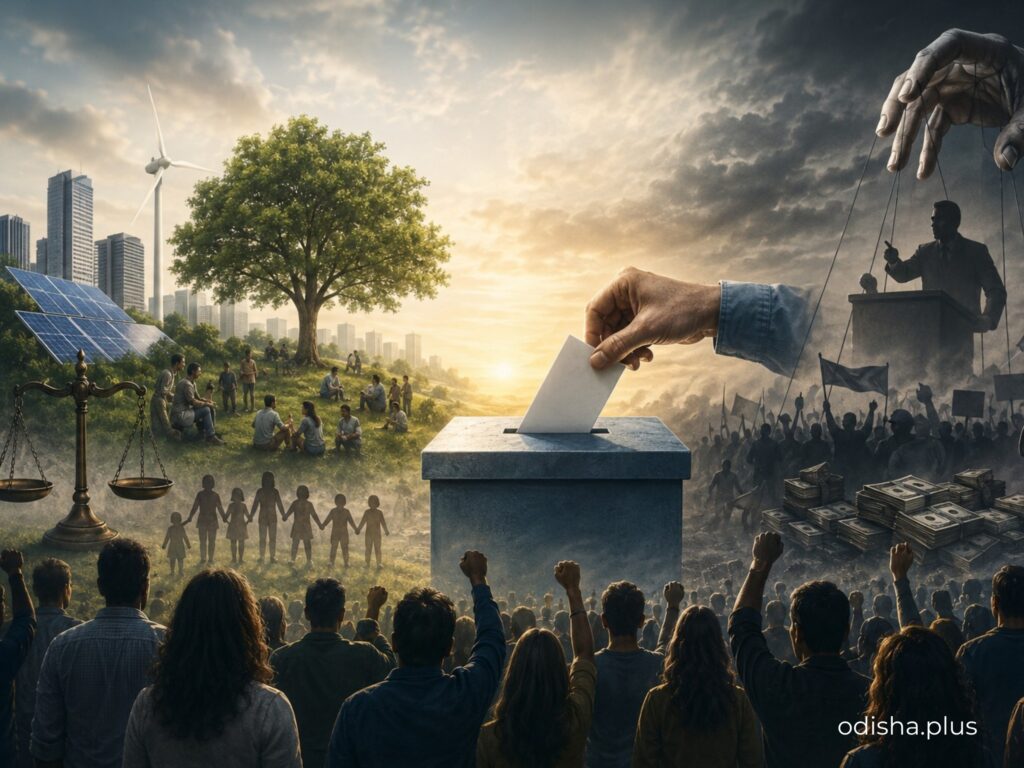
In the 21st century, restoring economic security and rejuvenating democracy has drawn the attention of every citizen and the mass media. Democracy, which started in the Greek city-states and marched forward to emerge as one of the best forms of government, now faces public ire as it tries to reconcile greater participation with values like deliberation, pluralism, and compromise. Good governance, accountability, and the majoritarian principle were the cardinal milestones upon which democratic values were built. But there is a fundamental shift in democracy, as in the 21st century it confronts one of the social maladies: post-truth. Of course, the intention of this article is not the reinvention of the wheel, but the reinvention of good governance, amidst global headwinds and local problems. All said and done, democracy is the best form of government, because it goes on reshaping human values, aspirations, governance, and economic growth.
Today, a situation has arisen where it is people versus democracy, as our freedom seems to be imperilled. Have globalisation, the rise of xenophobic nationalism, and crony capitalism endangered democracy? Has it degenerated to such a level that wealth distribution and inequality remain the major concerns of the 21st century? In the long and arduous journey of democracy, has it entered a narrow lane, where welfare is thrown into the dustbins of time? There appears to be a worldwide assault on democracy that pushes the boundaries of democracy, encompassing narrow party politics and self-interest. The UNO is seriously thinking of implementing a sustainable future by the year 2030, which, in all likelihood, is an impossibility, but at the same time, democracy can bring about sustainable development, social harmony, and natural justice.
Etymologically, democracy comes from Greek words: demos meaning people, and kratos means power, and thus, it stands for power to the people. French philosopher Rousseau advocated direct democracy through his concept of “general will which is an impossibility in today’s age of digital capitalism. Abraham Lincoln’s concept and definition of democracy, “of the people, by the people, for the people,” is by far, perhaps, the best one. Rousseau’s general will is also based on the concept of general Good and well-being that has remained the ultimate goal of democracy. It is different from autocratic rule, despotism, and oligarchy. Though it is built upon the concept of majoritarian rule, it never ignores the minority.
The idea of democracy hinges on freedom, equality, rule of law, individual autonomy to select one’s representative, human rights, and equal protection of the law. The Magna Carta is one of the milestones of individual freedom, emphasizing the fact that all human beings are born equal, and it is democracy which promises equality, freedom of choice, and fundamental rights without any discrimination on the ground of caste, class, place of birth, colour, gender, region, or social hierarchy. While democracy tries to protect freedom of thought, belief, faith, worship, freedom of peaceful assembly and associations, it has degenerated due to the malicious intentions of some pressure groups and political parties.
In the 20th and 21st centuries, democracy is confronting myriad challenges. The English philosopher John Locke’s thinking shaped modern liberal democracy. His hypothesis was based on the fact that power comes out of the “consent” of the people, and the powers that exist have to protect the natural, inalienable human rights. Locke also advocated the right to revolution when the elected government violates the social contract. Life, liberty, and property protection remain the greatest purpose of democratic government. The greatest ancient Greek philosopher, Socrates, was the most famous critic of democracy, and he argued that voting skill requires deep wisdom, rather than a right granted by birthright. Socrates was right, as we see manufactured consent, as it is seen in providing freebies, subsidies, reservations.
The pitfalls of manufactured consent are many, and it is a missile that destroys the fabric of democracy everywhere in the world. Degeneration is emanating from manufactured consent, not free will. Manufactured consent based on caste, religion, money, favours, violence, or the threat of it, ultimately is weakening democracy from within. Both Socrates and Plato were of the opinion that if the state is a ship, then it must be governed by a fit person. He is very right today even, while he argued that uneducated voters, without looking into the pros and cons of the party’s manifesto, and without analysing the past performance, are getting manipulated/ influenced and swayed away by smooth talking politicians who offers easy answers and though he swears in the name of truth on assumption of power, he seldom tries to protect the empty and false promises.
Money has a most disturbing impact on the exercise of manufacturing consent; otherwise, what we call voting. The lure of money subverts all democratic credentials, and values are thrown into the wind; people’s free choices are mortgaged in an election. A degeneration beyond repair. So much so that the common man is perplexed, the intelligentsia keep away from voting; force becomes the ultimate weapon, theft of ballot boxes, forcibly capturing booths, denying people with fear-mongering messages not to vote, are serious questions on the credentials of democratic exercise of free options.
Elections worldwide are conducted in an atmosphere of fear. There is peril within the promise; the average voter feels insecure, and his propensity and power to steer change get crushed under the disruptive force of hooliganism. With the appearance of online advertisements and post-truth, falsehoods spread like wildfire; the electioneering campaign is marked by violence, loss of life, and property. Social media is playing havoc in spreading the consummate passion of opposing candidates and fanning the worst violence. The cannons of law remain limited in controlling it. Thus, democracy is in decline, representative government is in crisis, and the participative power of social media is disruptive. This requires redrawing the social contract for free, fair elections. Now, things that affect the youth are joblessness, growth, and inequality in the digital age, and the focus has shifted from good governance to securing employment.
The biggest onslaught on democracy is from unbridled capitalism. The future of work is a big dilemma. Threats from capitalism are brewing public anger. Though capitalism and democracy are linked with each other, threat perception looms large. As capitalism is an economic concept, believing in the doctrine of free market and private property, best suited for democracy, but inequality is so much in capitalism that the poor hardly get a chance to exercise their free options, and the rich pocket all the cake. Thus, crony capitalism is making it an anathema. The schism between political and economic equality is widening.
Globalisation, a complex subject for the common man, though it thinks of as the economic integration of the world; yet, because of the force of globalisation, the poor feel marginalised in the decision-making process as big money dictates everything. Today, digital platforms expand civic participation. At least the vote of the poor remains closed in an EVM ballot box, with a checking system that guarantees a free and fair poll. The internet has been instrumental in allowing citizens to participate, with open access and faster outreach. But at the same time, automated advertisements make it hard for voters to know what is true, in view of their limited knowledge. Therefore, there must be digital literacy to make it happen.
The crisis of liberal democracy, without informed decision-making and compromised rights, makes it hollow from within. Democracy, therefore, is deconsolidating. Global headwinds, geopolitics, war, breaking of supply chain, inflation etc leading to economic stagnation and degrowth, making the democratic form of government weak. What is needed of the hour is that, in this turbulent time with growth slowdown, each government has to fix growth and the economy.
Much more important than that, the government of the day should renew civic faith by governance and by making the representative accountable. Defection is a hydra-headed monster. The above are the reasons why democracy no longer has the same hold over our thinking. Populism is not the answer. Ad hocism is not the panacea. Accountability is the keyword to enliven the social contract. There should be electoral reform, and ultimately it is the people who are the protectors of citizens’ rights who must rise to the occasion and steer clear of the inconsistencies. That is why the noted British author E. M. Forster wrote his book Two Cheers for democracy” and not Three Cheers.
(The writer is a former General Manager of Bank of India. Views expressed are personal.)