





















Dahi Handi offers a powerful lesson in teamwork, showing how trust, communication, role clarity and shared goals enable individuals to achieve collective success
Dr Aditi Panda
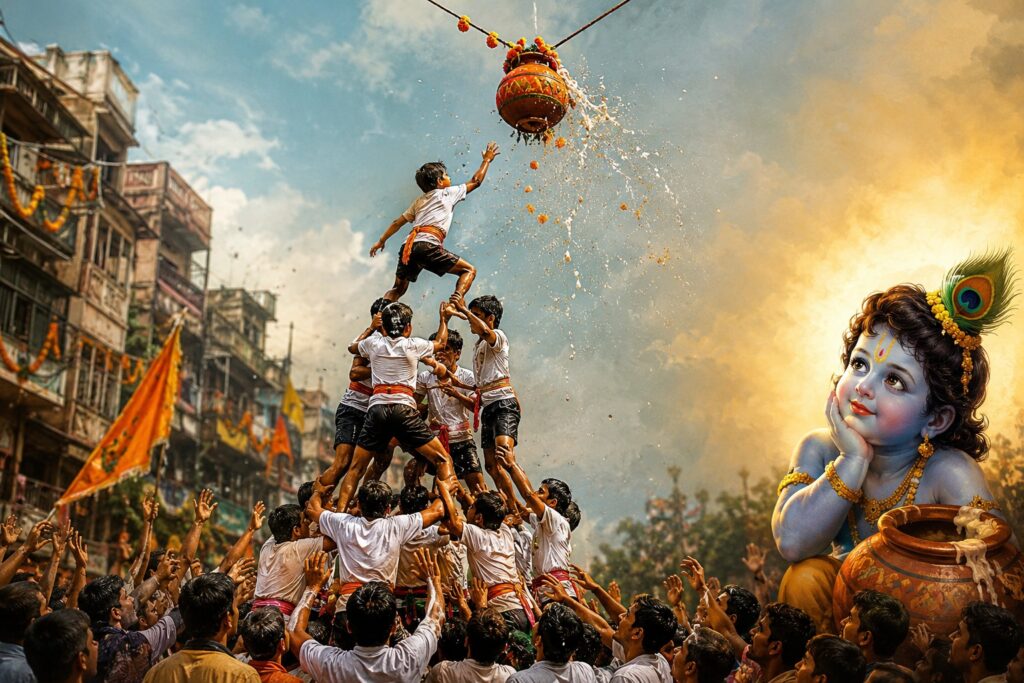
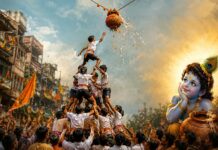
India is eager to celebrate Janmashtami, the birthday of our mischievous Lord Krishna, in diverse ways. One of the most famous practices connected to Bal Krishna’s early years, which originated in Maharashtra, is Dahi Handi, a stunning custom that has grown into an exemplary celebration from a pleasant fabrication of butter, friendship, and creativity. The sounds of dhols and chants of “Govinda Aala Re!” fill the streets as tall human pyramids ascend toward a pot held high above the ground, precisely one day after we celebrate our beloved Kanha’s birthday. The Govindas below are showered with curd and goodies when the handi breaks moments later.
Taking a cue from the legends surrounding this incident, it was simple. When Krishna was a child, he and his friends enjoyed freshly churned butter and curd, and the children’s gang, led by Krishna, went into homes and devoured everything. The village gopis, or milkmaids, hung their earthen pots from the ceilings, out of Krishna’s reach, to keep the churned butter away from this mischievous bunch. To get to the hanging pots and feast on them, Krishna and his cowherd friends built collaborative human pyramids.
As the pyramids grew higher, what had begun as an easy tradition gradually evolved into a serious matter requiring extensive planning and research because it involves cooperation, trust, communication, and teamwork to reach a common objective, which is breaking the handi at the highest point of a human pyramid. Transforming Dahi Handi into a potent example of a team-building activity of the present day reflects the dynamics of the workplace, where cooperation, role clarity, and support from one another are crucial for performance.
The goal of the Dahi Handi team is to break the handi, which can only be achieved if each member contributes adequately, just like in the workplace or a project team. This encourages a feeling of group accomplishment. Role clarity is crucial since each step of the pyramid has a clear responsibility. Just as the middle layers in the Dahi Handi pyramid ensure balance and support while the base members offer strength and stability, the middle tier in the team pyramid balances the higher and lower hierarchies. The climber at the summit shows bravery and dexterity. The way working groups in organisations are expected to allocate assignments according to capabilities is reflected in this standardised division of responsibilities.
In the area of trust and dependence, climbers depend on the base and middle layers for stability, and the base has trust that climbers won’t lose their footing. Interpersonal trust is strengthened by this reciprocal reliance. The communication teams are expected to continuously communicate with and guide climbers, modify positions, and support one another. Transparent communication is crucial to achieving the goal. Effective communication guarantees safety and keeps things from collapsing. As the teams practise often, learning from mistakes and refining tactics, they become more resilient and adaptable. This fosters adaptation and resilience, two qualities that are crucial in work settings and teams to perform together.
Dahi Handi also stresses teamwork since everyone must adhere to the motto “One Team, One Goal”, and no one can succeed on their own because the pyramid demands group effort, emphasising the value of cooperation over individual heroism. Looking back at how the team leader may find the right person for the right role to form the team is also valuable. Stronger members make up the base, while agile members ascend in a manner akin to that of companies that need to assign workers to positions that correspond to their strengths.
As learners primarily exercise balance, strength, and coordination, Dahi Handi management effectively teaches competency development in teams. This relates to teaching staff members to develop the necessary abilities for success in management. Additionally, it educates managers on the need for cross-functional cooperation by illustrating how each layer must coordinate flawlessly, strengthening interdepartmental coordination. The skill of handling obstacles is another important lesson to be learned from this traditional, informal team-building scenario. During an event, water splashing represents outside obstacles. Teams learn how to maintain concentration in the face of distractions.
Successful and fruitful teamwork is demonstrated so beautifully by Dahi Handi in its most basic form. Everyone has a part to play; some provide balance in the middle, others supply strength at the base, while others rise to the objective. The pyramid would fall apart in the absence of support, communication, and trust. However, success is shared by everybody when everyone participates and the group works together. This joyous custom serves as a reminder that team building is about cooperation, unity, and sharing successes rather than individual glory, while keeping in mind that we rise together and also fall together.
Let’s look at Dahi Handi as a sincere but effective illustration of teamwork rather than just a joyous custom. It provides an easy way to teach the fundamentals of team building by demonstrating how communication, role clarity, trust, and shared goals lead to success. This cultural metaphor can be used by educators and trainers to assist the genre next realise that cooperation and togetherness are the real underpinnings of success, with equal space and growth for all.
(The author is a development sector professional. Views expressed are personal.)