





















Can the smartphone be seen as the Kalki Avatar of the digital age? This thought-provoking essay examines how technology has reshaped communication, attention, and the human capacity for reflection
Rabindra Kumar Nayak
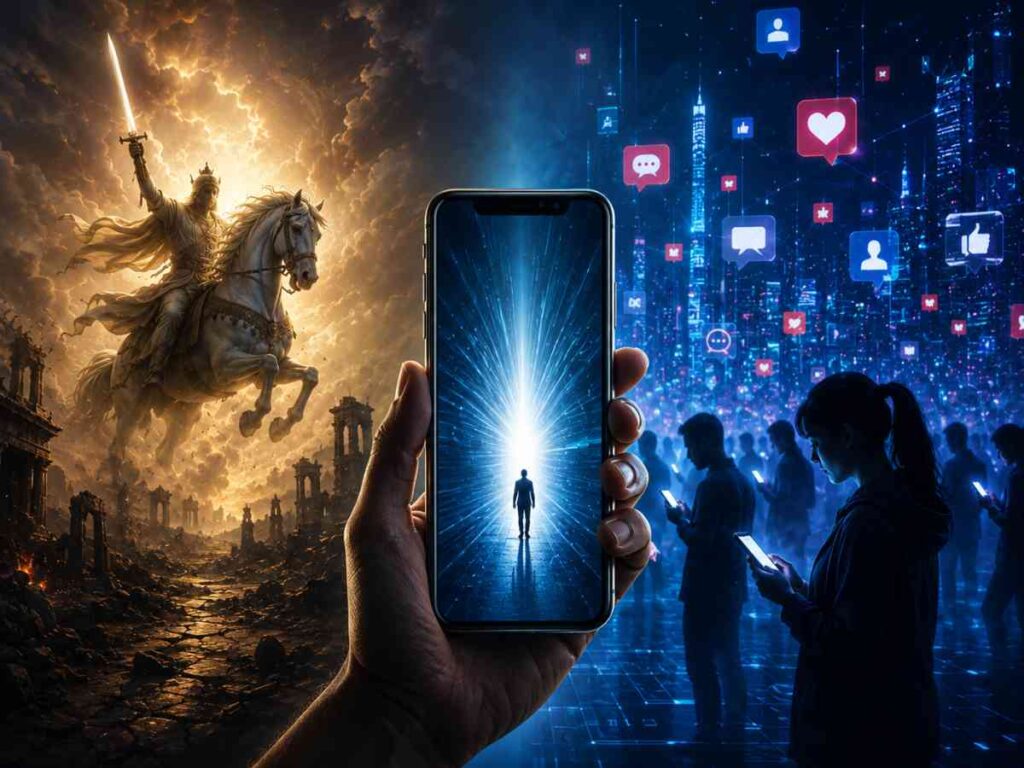
The Hindu imagination envisions Kalki as the final avatar of Vishnu, destined to appear at the end of the Kali Yuga. Mounted on a white horse and wielding a blazing sword, Kalki is expected to destroy a decaying world order and inaugurate a new age. Whether one interprets this prophecy literally or symbolically, Kalki represents a force that radically transforms human existence by bringing one era to a close and ushering in another.
If we search for a comparable force in the contemporary world, one candidate stands out: the smartphone.
Unlike Kalki of mythology, the smartphone does not ride a celestial horse. It rests quietly in our palms, glows from our pockets, and sits beside our beds. Yet its impact on human life has been no less revolutionary. In a remarkably short span of time, it has altered the way we communicate, work, learn, remember, travel, love, and even think.
The most profound change, however, may be its conquest of solitude.
For thousands of years, human beings lived with periods of silence. Farmers resting beneath trees, shepherds watching their flocks, travellers waiting at roadside inns, students gazing out of windows, and elders sitting in courtyards all experienced intervals of leisure time. These moments of silence often became occasions for reflection, imagination, prayer, memory, and self-discovery.
The smartphone has fundamentally changed this condition.
Today, the moment boredom appears, we reach for the device. A train journey becomes an opportunity to scroll through social media. A waiting room becomes a place to consume videos. Even moments of grief, loneliness, or uncertainty are quickly filled with digital distractions. Increasingly, we are connected to everyone except ourselves.
This transformation has brought undeniable benefits. Smartphones have democratised information, enabled instant communication, and expanded educational opportunities. They have connected families separated by continents and provided access to knowledge that previous generations could scarcely imagine.
Yet every technological revolution has its hidden costs.
The smartphone has created a culture of permanent attention and constant stimulation. Notifications interrupt conversations. Social media encourages comparison and performance. The pressure to remain visible and connected often leaves little room for contemplation. In many cases, visibility has begun to substitute for credibility, while constant activity is mistaken for meaningful engagement.
The result is a paradox. Never before have human beings been so connected, and yet many report feelings of loneliness, anxiety, and alienation. The device that promises connection sometimes weakens our relationship with ourselves.
Philosophers from many traditions have emphasised the importance of stillness. The Upanishadic sages sought truth in silence. Buddhist meditation cultivates awareness through attentive presence. Modern thinkers have likewise argued that self-knowledge emerges when external distractions recede.
The smartphone challenges this possibility by ensuring that distractions are always within reach.
In this sense, it resembles a modern Kalki. It has brought an end to an older world of waiting, wondering, and quiet reflection. It has destroyed one mode of existence and established another. Whether this transformation represents progress or decline remains an open question.
The challenge before us is not to reject technology but to use it wisely. Smartphones are tools, not masters. They can expand human freedom or diminish it, depending on how they are employed.
Perhaps the real task of our age is to recover the capacity for solitude without abandoning the benefits of connectivity. We must learn once again how to sit quietly, to think deeply, and to remain present to ourselves. Otherwise, we tend to become perpetual consumers of information without ever understanding our own minds.
If Kalki signifies the end of one age and the beginning of another, then the smartphone may indeed be the Kalki Avatar of our time. Not because it carries a sword, but because it has transformed the very texture of human experience and compelled us to rethink what it means to be human in the digital age.
(The author is a former Reader in English. Views expressed are personal.)