




















As the central government rapidly accelerates its ethanol-blended fuel program to cut crude oil imports, the forceful rollout of E20 without adequate preparation or choices at the pump has ignited widespread public uproar and protests among vehicle owners across the country
Nilambar Rath
India is currently in the middle of a massive energy transition, but for the common vehicle owner, this shift is increasingly feeling like an expensive, unconsented experiment.
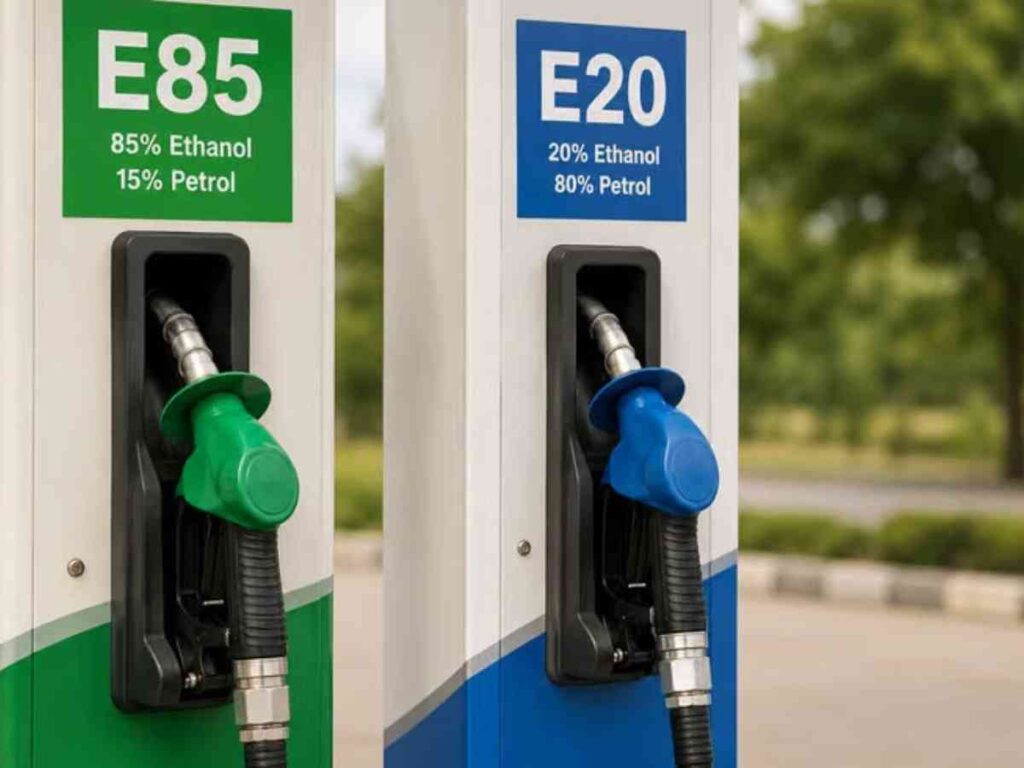
Over the past few years, the Government of India has aggressively fast-tracked its ethanol blending program. What started as a gradual mixing of ethyl alcohol into standard petrol has rapidly escalated to E20—a fuel blend consisting of 20 percent ethanol and 80 percent petrol.
With the government already preparing the groundwork for E27 and E30 blends, a nationwide backlash is quietly boiling over. From social media outrage to organized public protests across various cities, citizens are raising their voices against a policy that they feel is being forcefully imposed on them without giving them the time, the technical readiness, or the basic right to choose the fuel their vehicles actually need.
To understand the core of this conflict, it is essential to look at what ethanol blending actually is. Ethanol is a biofuel primarily derived from agricultural outputs like sugarcane, corn, and broken grains. By mixing it with standard fossil fuels, the government aims to achieve three major goals: drastically reduce the country’s dependence on imported crude oil, cut down vehicular pollution by utilizing a cleaner-burning fuel, and boost the agricultural economy by turning farmers into energy producers.
On paper, it is a visionary policy. In practice, however, it is creating a logistical and financial nightmare for millions of Indian households.
The primary issue lies under the hood of the cars and two-wheelers currently dominating Indian roads. There are over 40 crore registered vehicles in the country, and the vast majority of those purchased before 2023 were engineered strictly to run on pure petrol, or at most, an E10 blend. Pouring E20 fuel into these older engines is scientifically proven to cause a host of mechanical issues.
Ethanol is highly corrosive and has a tendency to absorb moisture. When fed into older, incompatible engines, it leads to the rusting of engine components, choked fuel tanks, and degraded rubber pipes. Across the country, mechanics are reporting a sudden surge in vehicles arriving with starting troubles, stalling engines, and ruined fuel delivery systems.
Beyond the severe wear and tear, there is a direct financial hit on the consumer due to a noticeable drop in mileage. Ethanol inherently possesses a lower calorific value compared to pure petrol, meaning it generates less energy when burned.
Even the government’s own think tank, NITI Aayog, previously published a roadmap acknowledging that E20 fuel can cause an average mileage drop of 6 percent in vehicles not specifically tuned for it.
Independent automotive researchers and daily commuters report that this drop can often be much steeper. Consequently, the common man is being forced to pay the exact same price at the petrol pump for a blended fuel that not only threatens to damage their engine but also forces them to refuel more frequently.
Automakers are indeed adapting to this new reality. Modern vehicles are now being manufactured as “Flex-Fuel Vehicles” (FFVs). These upgraded machines feature specially coated, corrosion-resistant engine components, larger fuel injectors, and advanced sensors capable of identifying and adapting to anything from E20 up to E85 blends.
However, this ecosystem of flex-fuel vehicles is still in its absolute infancy in India. The public grievance is rooted in the fact that the fuel is being aggressively rolled out years before the corresponding vehicles have widely penetrated the market, leaving existing car owners stranded with no alternative.
Despite the growing anxiety, the central government has remained fiercely defensive of the rapid rollout. Union Minister for Road Transport and Highways, Nitin Gadkari, who has been the primary architect and vocal champion of the green energy push, has faced serious criticism from the public. However, he maintains that the opposition to the policy is a manufactured narrative.
Gadkari recently hit back at critics, stating clearly that a powerful lobby is working to oppose India’s green energy vision. He claimed that the vested interests who make enormous profits from India’s ₹22 lakh crore crude oil imports are the ones actively spreading false propaganda about ethanol damaging engines, strictly to protect their lucrative import margins.
While the minister views this through the lens of national security and economic sovereignty, the citizens are struggling with practical, everyday realities.
This disconnect was further highlighted during a recent Supreme Court hearing on a Public Interest Litigation against the mandatory E20 rollout. During the proceedings, the government clarified that ethanol blending is a solid policy, not a trial, yet there remains a glaring absence of comprehensive, publicly released, government-authenticated studies detailing the exact long-term impact of E20 on older engines.
Even Petroleum Minister Hardeep Singh Puri recently conceded in public statements that mileage might “drop a little,” a casual acknowledgment that did not sit well with consumers watching their monthly fuel budgets inflate.
Critics and policy experts frequently point to Brazil as the ultimate benchmark for a successful ethanol transition, yet they highlight how India is ignoring the most crucial lessons from the Brazilian model.
Brazil began its ethanol journey back in 1975. They spent half a century carefully building the infrastructure, incentivizing citizens with tax rebates, and giving automobile companies years to perfect flex-fuel engines before making higher blends the standard. Most importantly, Brazil empowered its citizens with choices. Even today, at a Brazilian fuel station, a consumer can choose to fill up with varying blends depending on what their specific car can handle.
In stark contrast, Indian consumers are being stripped of their choices. Pure, unblended petrol is rapidly vanishing from fuel stations across the country, replaced quietly by E20.
The ongoing public protests are not against the concept of green energy or empowering farmers. The uproar is against the haste and the heavy-handed nature of the implementation. For a policy to be truly successful and pro-people, the transition must be fair. Until the country’s vehicle fleet is naturally replaced by flex-fuel engines, citizens argue that it is the government’s ethical responsibility to maintain pure petrol options at the pump, ensuring that the financial burden of the nation’s green ambitions does not fall unfairly on the shoulders of the common man.
(The author is a senior journalist and communication specialist. The views expressed are personal.)
Thought-provoking article! 👍 It explains the concerns around E20 fuel in a simple and easy way. Big policy changes work best when people have clear information and enough time to adapt. Thanks for sharing such a detailed perspective on the topic. 🚗📖😊
The shift to cleaner fuel is important, but people also deserve clear information and real choices. 🚗⛽ A smooth transition with proper planning and transparency will help build trust and make new policies easier for everyone to accept. 👍😊