











Explore the METAMORPHOSIS art exhibition at Lalit Kala Akademi, Bhubaneswar, highlighting how contemporary works preserve cultural memory and identity
Lipsa Sahoo
“Art is the expression of emotion,” wrote philosopher R.G. Collingwood. This idea echoed throughout the art exhibition I visited. Each canvas carried fragments of its creator’s life: personal struggles, unforgettable memories, quiet observations, and unspoken emotions transformed into colour and form.
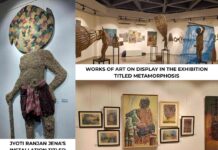
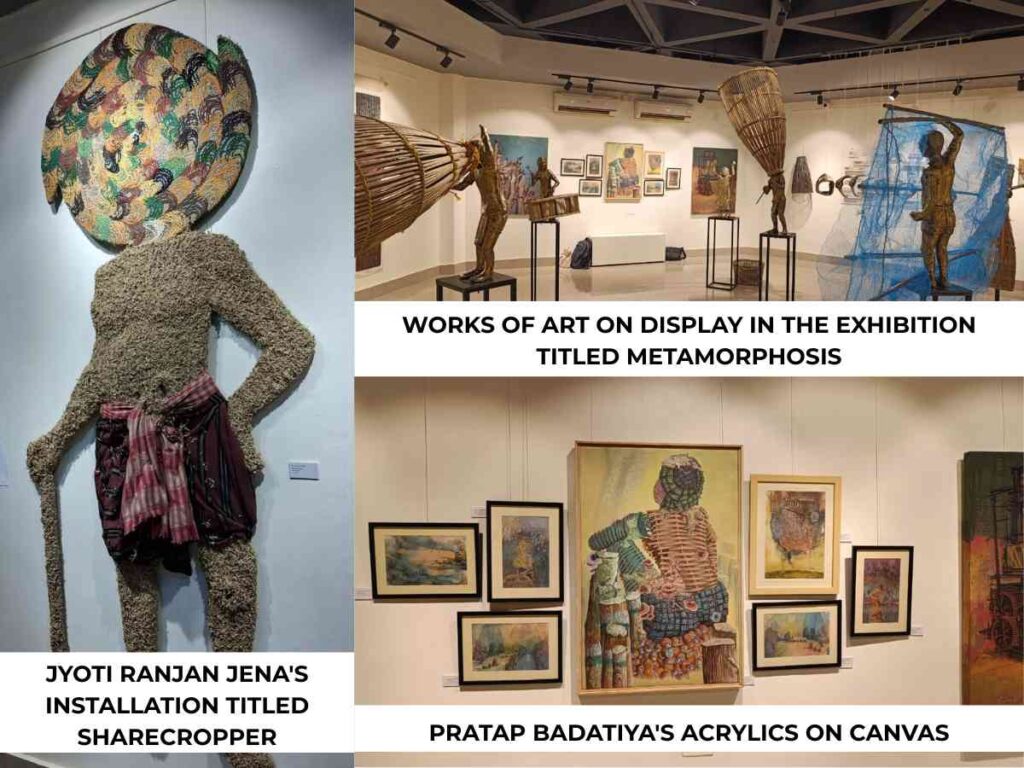
Hosted at Lalit Kala Akademi Regional Centre, Bhubaneswar, the exhibition METAMORPHOSIS, which opened on 24th July and is currently on display, brought together works by several research scholars of the Akademi from the previous year. Stepping into the gallery instantly transported me to a surreal world—a world where ideas and emotions embraced me through a visual passage. The calm, reflective ambience presented creations in a variety of media, including terracotta, woodcut prints on paper, and acrylic paintings on canvas, to name a few. Although every artist had a distinct visual language, certain ideas repeatedly surfaced.
Many of the artworks were deeply rooted in the artists’ lived experiences. In paintings such as Obligation and Ostracism (I), Pratap Badatiya draws from his own personal struggles of balancing education with earning a livelihood. His other paintings, including Ostracism (II), speak about his family’s painful experience of being ostracised. Another example is Jyotiranjan Jena’s Sharecropper series, which lays bare the struggles of his sharecropper community in the face of natural calamities and a legal system that overlooks their labour and rights. While one rooted his work in ostracism and personal burdens, another transformed his lived experience into a broader exploration of communal struggles. Both of their personal stories gradually became social narratives.
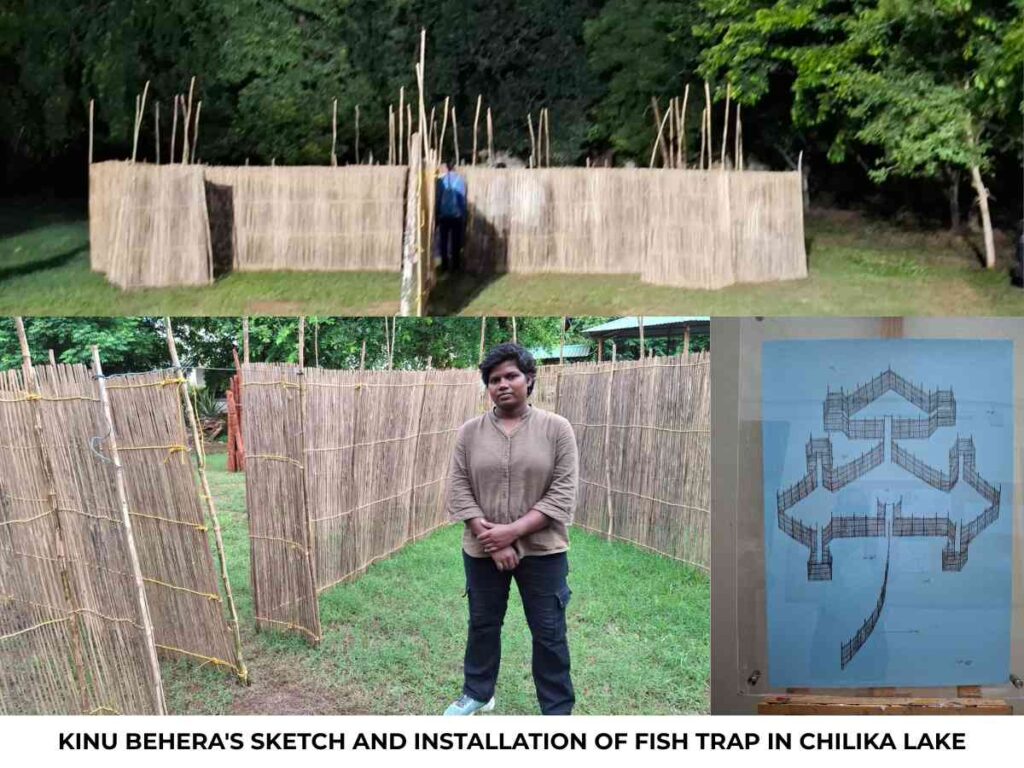
Cultural identity continued to emerge as a strong motif in the works of both Badatiya and Kinu Behera. The former’s signature bamboo weaving pattern could be seen consistently across all his artworks. As he explains, this bamboo weaving pattern is inspired by the history and cultural identity of his village. I recall asking him, “Would it not be easier, more convenient, and less time-consuming to abandon these weaving patterns?” “Yes, but it will lose its depth,” he replied with a smile. Similarly, the latter, who belongs to the Kandara (Scheduled Caste) fishing community, centres all her artworks around fishing culture. Her terracotta, bamboo, and bronze artworks feature installations of traditional bamboo fish traps alongside sculptures of fish and fishermen. One of her bronze sculptures that stayed with me depicts a fisherman with a huge bamboo fish trap (Gumura) covering his head. As the artist explains, this suggests that fishing has become his entire identity, eclipsing even his visage. Their shared vision helped me realise that cultural identity is lived rather than merely remembered.
Now, art is not always about personal pain. Sometimes, it is about the suffering of the subaltern. Such portrayals, however, require sharp yet empathetic observation of life. Initially, one question bothered me: “Can art really speak for people other than the artist with the same intensity?” After experiencing the artworks of Amiya Ranjan Ojha, I can confidently answer in the affirmative. Observation requires empathy, and empathy creates a voice. Through woodcut prints on paper, Ojha meditates on realities that many viewers overlook. His artwork The Growing Burden is an excellent example of how innocent villagers become trapped by the hope of employment. One of his works that compelled me to pause was The Gift of My Body. It dwells on the suffering of slum communities who are forced to surrender their already congested spaces to an unreliable government, drawing attention to their terrible living conditions. I found myself empathising with them. Many of Amiya’s artworks directly criticise governmental incompetence while revealing the struggles of middle-class families, rural communities, the homeless, and slum dwellers. Through observation, he critiques both society and governance. We can see glimpses of similar political criticism in Jena’s works, which draw attention to the empty promises made by politicians—promises that are forgotten the moment they come to power. Together, they reveal how different paths, such as observation and personal experience, can lead to a shared concern: political criticism.
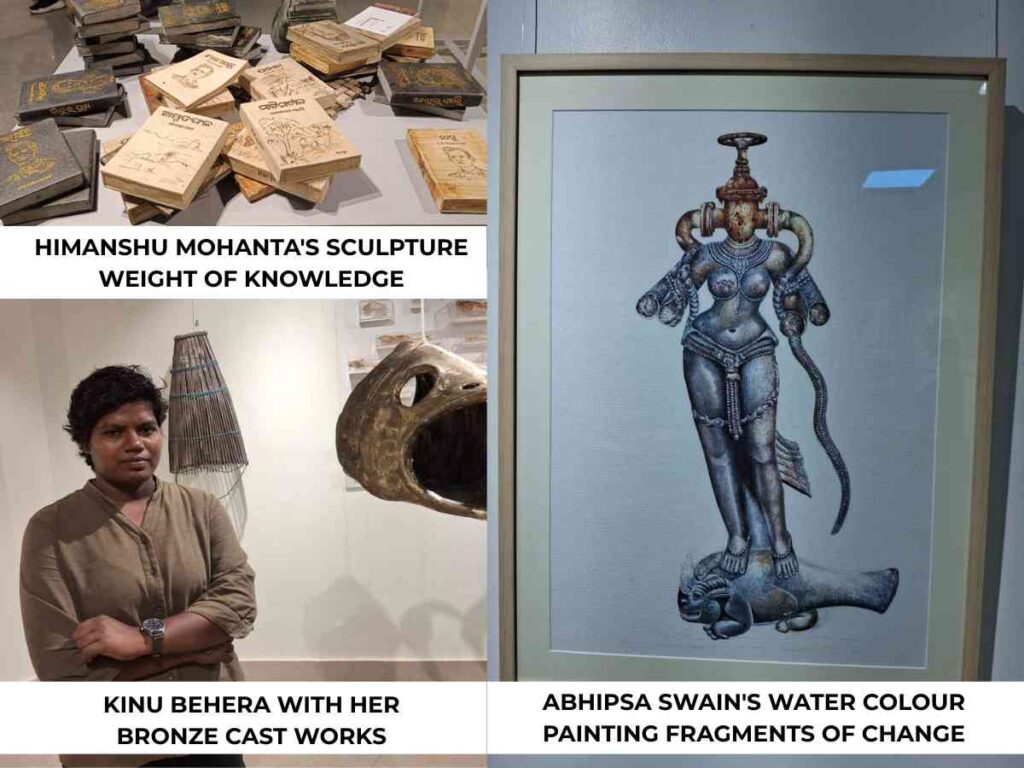
The deeper I wandered into the gallery, the more another facet of art gradually emerged before me: preservation. Through his realistic rock and ceramic sculptures, Himanshu Mohanta attempts to preserve the physical memory of literature and everyday objects. His creations include sculptures of books, backpacks, traditional Gathri, and other familiar objects that often go unnoticed. On the other hand, Kinu’s collection of traditional fishing tools makes a similar attempt to preserve her identity and culture. Further along, I encountered Saraswati Angriya’s terracotta creations. Her works weave together fallen leaves, dried leaves, insect-chewed leaves, bamboo baskets, and jute bags. When asked about her works, she said something interesting: “All the patterns that we use already exist in nature—in insect-chewed leaves, for example. I just wanted to bring that into focus through my sculptures.”
All of these artists engaged with the idea of preservation. Whereas Himanshu tries to preserve forgotten everyday objects, Kinu seeks to preserve fishing culture, and Saraswati attempts to preserve nature’s own designs.
My attention was soon drawn to the watercolour paintings of Abhipsa Swain. As an extension of the idea of preservation, she complicates it by suggesting that preservation does not always mean keeping something unchanged. Sometimes, traditions, identities, and memories endure by transforming while retaining their essence. I drew this idea from her portrayal of fragmented, seemingly unrelated pieces fused together. It felt less like destruction and more like transformation.
Reflecting further on this idea, I noticed something: almost every artist, in some way, is trying to engage with preservation, even if it is not the central theme of their work. Amiya tries to preserve unnoticed lives, Pratap tries to preserve tribal identity, Jyotiranjan tries to preserve the reality of sharecroppers, and Abhipsa seeks to preserve cultural memory through ruins and transformation. It seems that beneath the idea of emotion lies another thread: a desire to hold on to something that is at risk of being forgotten, changed, transformed, or overlooked.
Looking back, every artist, even those whose works I could only briefly encounter, such as Sudarshana Routray’s oil paintings, added a distinct voice to the exhibition. Yet together, they formed a conversation rather than a collection of isolated works.
I admit that I entered the gallery believing that “Art is the expression of emotion,” but this exhibition greatly expanded my understanding of both this quote and art itself. As I left, I realised that art is not only an expression of emotion. Art also remembers. Art questions. Art preserves. Art observes. Art bears witness.
(The writer is currently pursuing a Master’s in English Literature at Ramadevi University. Views expressed are personal.)