






















Union Minister Jitendra Singh and Odisha Minister Krushna Chandra Patra discuss expanding rare earth exploration, marine research, and biotech in Odisha
OdishaPlus Bureau
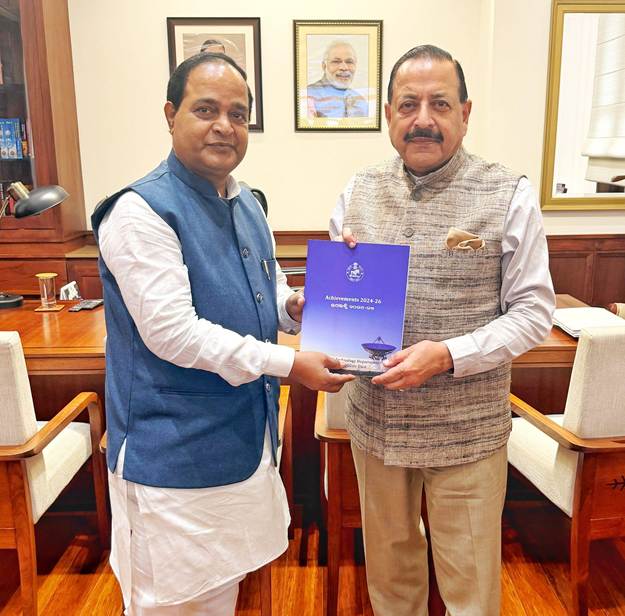
The Centre will expand exploration for rare earth elements in Odisha under the proposed ‘Rare Earth Corridors’ announced in the Union Budget 2026-27, Union Minister for Science and Technology Jitendra Singh said on Tuesday following a meeting with Odisha Science and Technology Minister Krushna Chandra Patra.
The meeting focused on integrating Odisha’s science and technology initiatives into a broader national roadmap covering rare earths, marine sciences, biotechnology and space research, according to a press release issued by the Union Ministry of Science and Technology.
“The Eastern Coastal Region can play a much larger role in India’s emerging nuclear and marine roadmap, with Odisha well placed to contribute through coordinated efforts,” Singh said.
Rare earth exploration is expected to be a major area of cooperation between the Centre and Odisha, given the strategic importance of these minerals for sectors ranging from electronics and renewable energy to defence and advanced technologies.
The meeting also discussed expanding biotechnology research infrastructure in the State. The Institute of Life Sciences (ILS), Bhubaneswar, an initiative of the Department of Biotechnology, will be expanded with an additional 50 acres of land, taking its research infrastructure significantly beyond its existing eight-acre campus.
The expansion is expected to strengthen Odisha’s capacity to participate in major biotechnology initiatives, including the Biotechnology for Economy, Environment and Employment (Bio-E3) Project.
Marine science and the blue economy also figured prominently in the discussions. The ministers reviewed the Odisha Marine Biotechnology Research and Innovation Corridor (OMBRIC), launched by the State government last year to bring together major research institutions for collaborative work in marine biotechnology and related fields.
The initiative links institutions including IIT Bhubaneswar, Berhampur University, Fakir Mohan University, NIT Rourkela, IISER Berhampur and the Institute of Life Sciences, Bhubaneswar, among others.
With its long coastline and substantial marine resources, Odisha has argued that its coastal and ocean potential remains inadequately explored. Support from the Union Ministries of Earth Sciences and Science and Technology is expected to help State institutions undertake advanced research in marine sciences, marine biotechnology and resource exploration.
The proposed collaboration would complement India’s Deep Ocean Mission as well as Odisha’s Deep Sea Fishing Mission (2026-36), which aims to tap offshore and deep-sea fisheries potential while building stronger value chains around the State’s marine economy.
Space technology was another key area discussed during the meeting. Patra raised the possibility of integrating the Odisha Space Applications Centre (ORSAC) more closely with the Indian Space Research Organisation (ISRO).
Established in 1984, ORSAC undertakes satellite-based communication, remote sensing and earth observation programmes for sectors such as agriculture, mineral resources and data management.
The Odisha minister also made a case for establishing a space research and manufacturing facility in the State through a public-private partnership.
According to the Union Ministry’s statement, Singh and Patra agreed on the need for continued Centre-State coordination to advance the proposed initiatives.
The discussions signal a broader effort to position Odisha as an important hub for strategic minerals, biotechnology, marine research and space applications, bringing the State’s scientific institutions into closer alignment with India’s emerging technology and resource-security priorities.