















World Literacy Day 2026 asks whether education is just degrees and marks or the ability to think critically, learn, and participate meaningfully in society
Dr Aditi Panda
Teachers’ Day was celebrated with great enthusiasm on September 5th, when students, both past and present, paid tribute to their teachers and thanked them for shaping their lives. There is barely any time to consider the importance of the day we spent celebrating or honouring it because our calendar is filled with religious holidays and an endless number of days and observations. However, how many of us thought back on the accumulation of knowledge we had acquired through years of schooling and the time and effort we had invested in moving up the educational ladder to land a well-paying job that would fulfil all our dreams?
The main purpose of bringing out this angle is that we are celebrating World Literacy Day, which is observed worldwide on September 8th. This date was announced by UNESCO in 1966 during its 14th General Conference, and the first celebration took place in 1967. The day serves as a worldwide reminder that literacy is a fundamental human right and is essential for education, opportunity, and building equitable, peaceful, and ethical societies. “Literacy for people, the planet and prosperity” is the theme for 2026, which links literacy to economic growth, environmental sustainability, and social inclusiveness, with an emphasis on upcoming literacy initiatives in a world that is changing quickly.
Is literacy, in the real sense, restricted to the capacity to read and write words, or does it entail being able to comprehend, evaluate, and use knowledge in ways that enable people to engage fully in society, think critically, and communicate effectively? People who are truly literate can access opportunities, make informed decisions, use their agency judiciously, and support social and economic progress. It is about developing awareness, ingenuity, and self-confidence to interact with the environment in a meaningful way, not just interpreting letters on a page.
Literacy plays a transformative role in social empowerment because it provides people with the tools to question disparity, claim their rights, and participate meaningfully in their respective environments. People are better equipped to acquire information, participate in decision-making, and advocate for themselves when they become literate, particularly women, members of underrepresented groups, and people with disabilities. Literacy increases self-confidence, lessens reliance, and creates opportunities for leadership, work, and education. In this sense, it becomes more than just a skill; it becomes a force for breaking down social barriers, promoting inclusivity, and creating societies in which all voices are respected and heard.
This is what literacy implies in a broader sense, which leads to the question of whether our educational system is truly capable of doing this or whether the concept of literacy has completely changed for this generation, or GEN Z, as they are known nowadays. These days, literacy is assessed by the percentage or rank obtained in exams, starting at the kindergarten level.
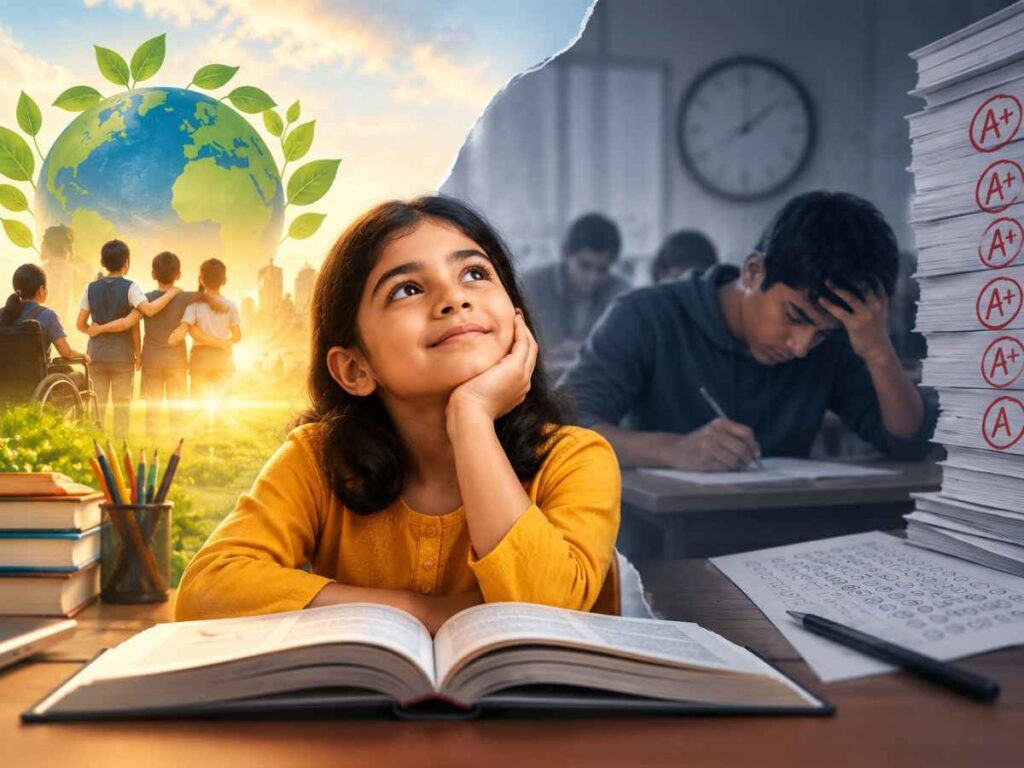
Exam scores have taken precedence over the actual goal of learning in today’s educational system. Children’s originality and depth of learning are sometimes overlooked in favour of numerical scores. Instead of encouraging students to engage with topics meaningfully, this concentration on grades turns education into a race for high marks. As a result, grades become the only indicator of success, and the joy of learning and the development of critical thinking are neglected. A system like this runs the risk of creating people who do well on tests but lack the abilities and curiosity necessary to succeed in real life.
Examination culture has deeply influenced modern education, frequently at the expense of real learning, according to critical examination. The system’s mania for grades and rankings turns information into a commodity and promotes rote memorisation over originality and critical thought. Students are under pressure to perform within strict frameworks, where success is determined more by test results than by intellectual development or problem-solving skills. This culture discourages curiosity, teamwork, and holistic growth in favour of anxiety, competition, and compliance. Furthermore, regardless of true comprehension, people who have access to greater coaching or resources frequently perform better than others, perpetuating inequity. Exam culture essentially runs the risk of creating people who are exceptionally good at passing exams but lack the flexibility and deeper abilities required to address problems in the real world.
Assessment-focused education must give way to authentic learning that fosters critical thinking, creativity, and curiosity. Schools should prioritise comprehension, inquiry, and the application of concepts in real-world situations rather than reducing knowledge to grades and rankings. Children who receive a real education are better equipped to tackle difficult problems outside the classroom because they are empowered to ask questions, think creatively, and work together. We can build an educational system that produces thoughtful, competent, and socially conscious people rather than just test-takers by prioritising skills, problem-solving, and holistic development over rote memorisation.
The control of exam culture has narrowed the meaning of education, reducing it to a chase for marks rather than a journey of growth. We must rethink education as a process that emphasises critical thinking, creativity, and curiosity if we are to genuinely prepare children for life. Students should be empowered by real learning to think critically, be creative, and make significant contributions to society. We can only create a generation prepared to confidently and wisely take on the problems of the future by moving away from grades and towards meaningful education, thereby creating a LITERATE world in the real sense.
(The author is a development sector professional. Views expressed are personal.)