






















The future of India will not be built merely in factories or laboratories; it will be shaped in classrooms where technology and human intelligence work together to create responsible, innovative, and skilled citizens
Manaswini Acharya
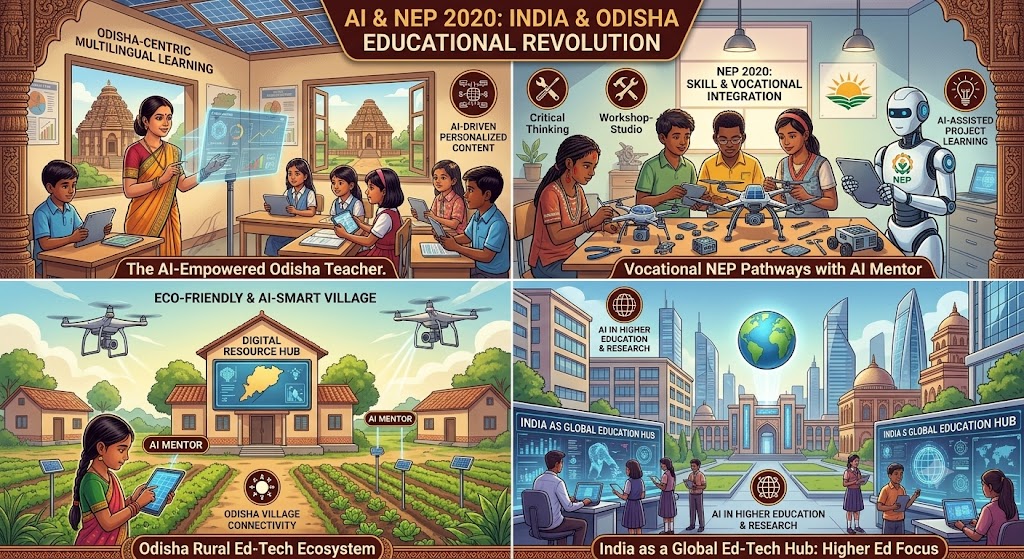
Imagine a student from a remote tribal rural area of Odisha learning science through an AI-powered application that identifies his weaknesses and provides instant answers in his mother tongue. Such a scenario, once considered futuristic, is now becoming a reality.
As India moves towards the historic milestone of completing 100 years of Independence in 2047, the nation has set an ambitious goal of becoming a Viksit Bharat (Developed India). To achieve this vision, it requires not only economic growth or technological advancement but also a strong education system. A nation with over 1.4 billion people, where nearly one-fourth of the population is below the age of 25, possesses a tremendous demographic advantage. India has one of the largest education systems in the world. According to the Unified District Information System for Education Plus (UDISE+), the country has more than 14.7 lakh schools, over 26 crore school students, and more than 95 lakh teachers. According to the United Nations, India has one of the world’s youngest populations, making education the most powerful instrument for transforming this demographic dividend into a global competitive advantage.
The emergence of Artificial Intelligence (AI) in India, coupled with the transformative reforms introduced under India’s National Education Policy (NEP) 2020, is revolutionising the education landscape. The main goal of NEP 2020 is to bring reforms to the Indian education system by moving from rote learning and memorisation towards practical-based learning, which enhances digital literacy, critical thinking, and creativity in learning. To fully realise the vision of NEP 2020, both the Government of India and the Government of Odisha must prioritise investment in digital infrastructure, AI literacy, teacher capacity building, data privacy, and ethical guidelines for AI use.
The rapid expansion of digital connectivity in India provides a favourable environment for AI-enabled education. According to the Telecom Regulatory Authority of India (TRAI), the country has more than 90 crore internet subscribers, while smartphone usage continues to grow rapidly. Government initiatives such as Digital India, PM eVIDYA, DIKSHA, and SWAYAM have helped students access several valuable digital learning resources, thereby leading to more democratic learning. Teachers will also benefit from AI through automated assessment, lesson planning, attendance management, and learning analytics. Instead of spending valuable time on repetitive administrative work, educators can focus on mentoring students, encouraging creativity, and developing critical thinking skills among themselves as well as among learners.
A common fear surrounding AI is that it may replace teachers. But, in practice, AI should be viewed as a tool that complements rather than substitutes educators. Teachers perform roles that machines cannot replicate, such as inspiring students, nurturing creativity, building values, and providing emotional support. However, the future classroom of 2047 should not be imagined as one where machines replace teachers. On the contrary, AI is most effective when it complements the role of educators.
AI also makes education more accessible. Students from remote locations can access quality educational resources, virtual tutors, language translation tools, and digital libraries at any time. For a diverse country like India, where educational inequality continues to exist between urban and rural regions, AI offers an opportunity to democratise learning.
While AI offers remarkable advantages, it also presents significant risks. Today, students can generate essays, assignments, presentations, and coding solutions within seconds using generative AI tools. Although these technologies can enhance understanding when used appropriately, excessive dependence threatens independent thinking, creativity, and originality. The growing misuse of AI has intensified concerns regarding plagiarism and academic dishonesty. One of the biggest obstacles to AI-driven education is unequal access to technology. Millions of students across rural India continue to struggle with limited internet connectivity, inadequate digital infrastructure, and the unaffordability of smart devices.
India stands at a crucial stage in its educational transformation. The future of India’s education system in 2047 depends on the successful integration of the visionary reforms of NEP 2020 with the transformative potential of Artificial Intelligence. Together, they can create an education system that is inclusive, innovative, and globally competitive. In essence, NEP 2020 provides the roadmap, while Artificial Intelligence offers the technological engine to achieve its goals. By combining advanced technology with quality teaching, ethical governance, and equitable access, India will move towards a generation of confident, skilled, and responsible citizens who will lead the nation towards the dream of Viksit Bharat 2047.
Odisha has already demonstrated its commitment to educational reform through initiatives such as the 5T School Transformation Programme, Mo School Abhiyan, and Odisha Adarsha Vidyalayas. These reforms complement the objectives of NEP 2020.
By integrating AI into these programmes, the state can improve personalised learning, teacher support, multilingual education in Odia, and school governance. Strengthening digital infrastructure in rural and tribal areas will ensure that Odisha contributes significantly to India’s vision of becoming a global knowledge leader by 2047.
Artificial Intelligence is neither a complete opportunity nor an inevitable threat. Its impact depends on how wisely it is integrated into the education system. NEP 2020 provides the policy framework, while AI offers the technological capability to realise its vision. Together, they can transform the education system to a new height, and the vision of Viksit Bharat @2047 can become a reality. Therefore, the real debate is not whether AI is beneficial or harmful; it is whether India is prepared to use AI responsibly in this new era.
(The author is a Research Scholar in Economics at Fakir Mohan University, Baleshwar. Views expressed are personal.)