





















Explore Bhaskar Parichha’s ‘Odisha: 500 Years of Turmoil.’ A comprehensive review of Odisha’s journey from historical struggle to modern resilience and identity
Suresh Chandra Sarangi
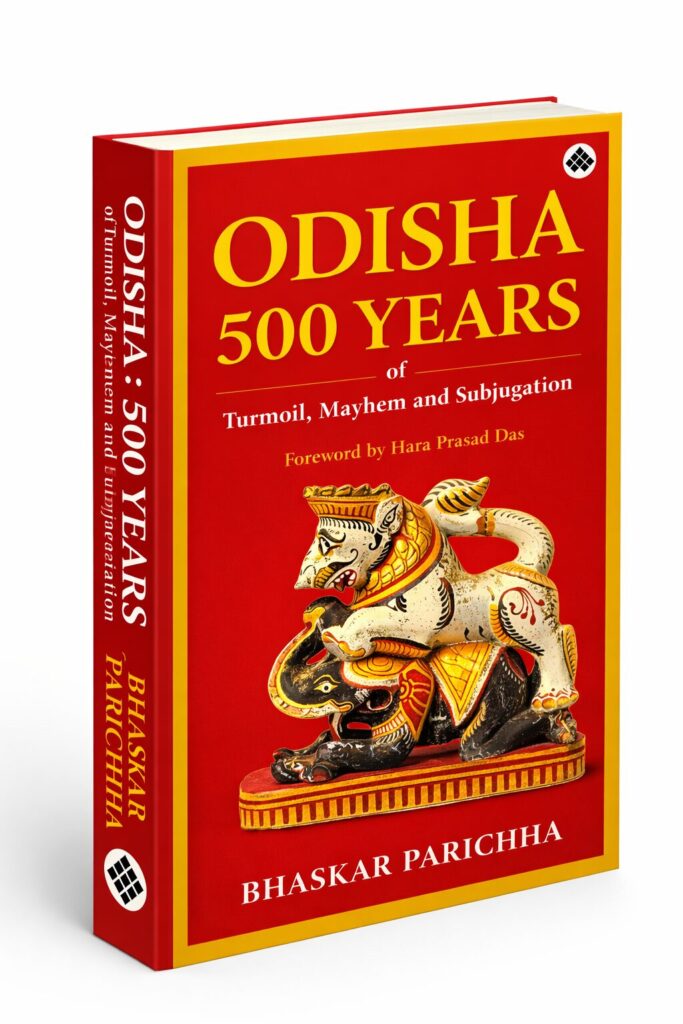
Book Name: 500 years of Turmoil
Author: Bhaskar Parichha
Publisher: Pen In Books, Bhubaneswar
It is said, “Brevity is the soul of wit.” In that sense, ace journalist Bhaskar Parichha’s book, Odisha – 500 Years of Turmoil, Mayhem and subjugation ‘, has already created ripples in the intellectual domain and in the minds of history-loving people. The high priest of history, E. H. Carr, in his magnum opus, writes, “History would not be worth writing or reading if it had no meaning.” Parichha’s presentation of 500 years of Odisha’s history is a capsule that contains all the crucial challenges and possibilities, while seeking meaning and purpose.
This book is a procession of facts and events, governed by inexorable laws. It is the result of objective analysis, documenting the most monumental challenges of Odisha has confronted, written in lucid English, in an impassioned yet impartial manner, with remarkable objectivity. Things deeply embedded in Odishan culture—the valour of the warrior class and a liberal intellectual tradition—permeates the narrative in an impressive manner throughout the book, exhibiting the craftsmanship of the writer.
The cover of the book is unique, drawn from Odishan folklore. The structure of the book is well organised; it is not a history textbook but reads like a lyrical love story. The format, in that sense, is quite revolutionary, with a chronological arrangement of history that speaks and enthralls. Citations from the writings of Abu Fazal, Arnold Toynbee and Barrister Madhusudan Das make it compelling reading.
In his Foreword, noted literary critic and bureaucrat Haraprasad Das writes, “Odisha, for many, is either a glorious mystery that faded into civilizational history or an aspirational model of cultural osmosis that blends the North–South Vindhyan divide into a living whole.” That is the marvel of this history book—it not only chronicles, but enchants.
The narrative revolves around the concept of Odisha’s spiritual journey, politics, society, and economics. Parichha has beautifully captured the evolving politics through a quest for Odia identity, while striving to preserve rich traditions and welcoming modernity in an ever-changing cultural landscape. Odisha’s historical Maritime trade boasts a great legacy and a vibrant culture across the Bay of Bengal and far beyond India’s boundaries into Southeast Asia. There have been major shifts, of course, but the way Parichha chronicles them is rhythmic. The ups and downs—from the Na’Anka famine, a sad reminder of the apathetic and callous attitude of the British Empire, resulting in a colossal loss of lives, to the downturn after Mukunda Dev—are portrayed with depth and sensitivity. Equally striking are the triumphs of Kapilendra Dev, who envisioned an empire rooted in
Odisha’s culture. Nevertheless, the book delves into the aggression of the Marathas, the Afghan invasion, the Muslim period, and the tumultuous British era, weaving this intricate history has coherence and depth.
The Paika Rebellion, the Nilgiri movement, the Khurda Rebellion of 1804 and the integration of princely states under the stewardship of the first Chief Minister, Dr. Harekrushna Mahatab—including the Quit India Movement and the iconic guerrilla warfare led by Veer Surendra Sai, during the First War of Independence, is presented as living history, forming the flashpoint of the book.
After India became independent, Odisha marched on through trials and tribulations, yet never feels defeated. On the cusp of Independence, democracy finds its footing—with a farmer-first policy and an industrialising Odisha—continually battling natural calamities like floods and cyclones, yet standing like a solid rock after every disaster. What Parichha writes is the beauty of the resilience of the people of Odisha, and the spiritual leadership of Lord Jagannath, who, in legend, moves to the battlefield to fight for his sevak king.
The political landscape, once unstable after Independence has now stabilised, and a rising Odisha is carving a niche for itself nationally and internationally, as Parichha highlights. The changes in occupational structure, the rise of soft power, and modern farming practices, and industrial turnaround together narrate a story aligned with the national goals of economic and inclusive growth.
The book is about a rising star beyond the horizon, in the firmament of history—immensely readable and scrupulously enjoyable. Blending rigorous scholarship with an engaging narrative, it is a comprehensive exploration of Odisha over the last five hundred years. The analysis is insightful, the result of hard labor and scholarship, producing an erudite yet refreshingly accessible book that celebrates history as an act of curiosity, argument, and critical inquiry. Highly recommended.
(The writer is a former General Manager of Bank of India. Views expressed are personal.)