



















Rabindra Kumar Nayak reviews Dipti Ranjan Pattanaik’s collection, exploring the intersection of Advaita Vedanta, postcolonialism, and the metaphysical self
Rabindra Kumar Nayak
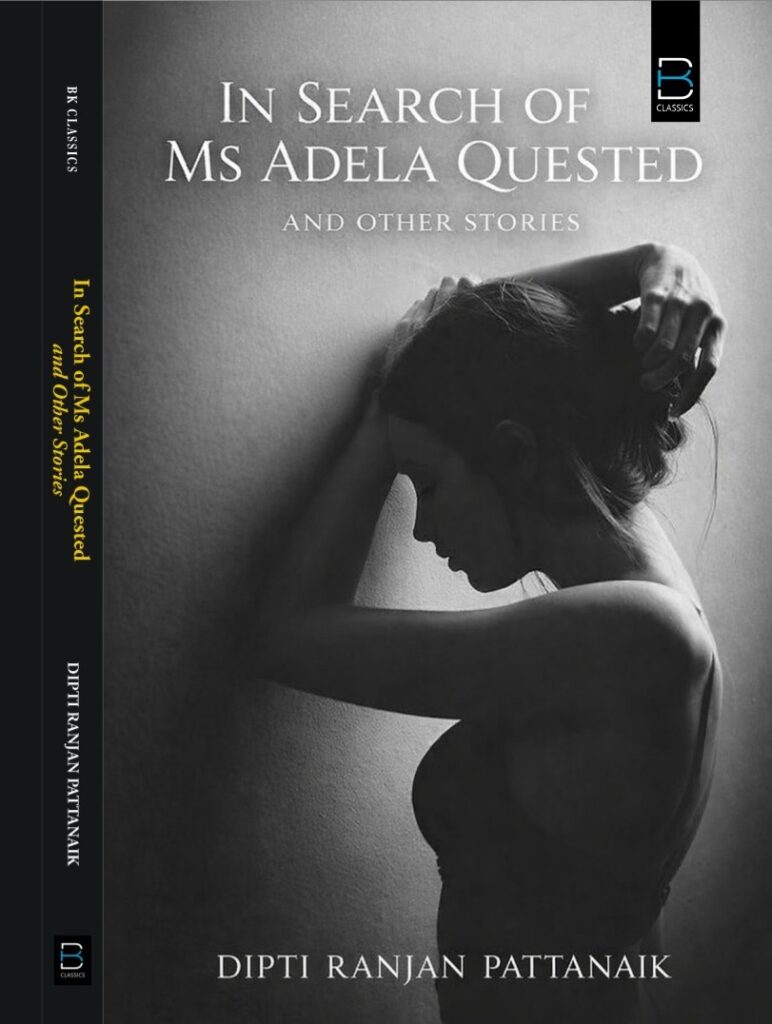
Book Name: In Search of Ms Adela Quested and Other Stories
Author: Dipti Ranjan Pattanaik
Publisher: BK Classics
Dipti Ranjan Pattanaik’s In Search of Ms Adela Quested and Other Stories is an ambitious and richly textured collection that seeks to transcend the conventional boundaries of short fiction. The seventeen stories, translated from Odia into English, operate at the intersection of narrative art, philosophical inquiry, and spiritual reflection.
While the collection is undoubtedly rich in thematic depth and cultural rootedness, it also raises certain critical questions regarding narrative density, accessibility, and aesthetic balance. At the thematic core of Pattanaik’s fiction lies a sustained engagement with existential loneliness, spiritual longing, and the fragile nature of human relationships.
The preface itself foregrounds loneliness as a “metaphysical condition,” rather than merely a social experience. This idea finds resonance across multiple stories. Characters are not merely individuals caught in circumstances; they are consciousnesses grappling with isolation, meaning, and transcendence. For instance, in “The Man Who Ran,” intimacy paradoxically intensifies loneliness, suggesting that human relationships cannot fully resolve the deeper ontological solitude of existence. Such insights elevate the stories beyond realism into the realm of philosophical fiction.
One of the most striking aspects of Pattanaik’s work is its engagement with Indian philosophical traditions, particularly Advaita Vedanta. Stories like “The Host” dramatise non-dualistic ideas such as the dissolution of the self and the illusory nature of life and death. Unlike many contemporary writers who treat spirituality as either ornamental or escapist, Pattanaik integrates it into the very fabric of narrative experience.
Spiritual realisation emerges not as an abstraction but as something lived through suffering, loss, and ethical engagement. This grounding of metaphysics in day-to-day reality is one of the collection’s major strengths.
Equally significant is the book’s postcolonial dimension. The title story, “In Search of Ms Adela Quested,” explicitly dialogues with E.M. Forster’s A Passage to India, revisiting the ambiguity of the colonial encounter. Rather than offering a simplistic inversion of colonial binaries, Pattanaik sustains ambiguity, suggesting that truth itself remains elusive across cultural and historical divides.
Similarly, stories like “The Four Dreams of My Mother” challenge Western intellectual hegemony by privileging indigenous knowledge systems over Freudian psychoanalysis. This deliberate assertion of Indian epistemologies marks the collection as a thoughtful intervention in postcolonial discourse.
Narratively, Pattanaik employs first-person perspectives and intricately structured storytelling techniques that create epistemological uncertainty. Reality is filtered through subjective consciousness, often unreliable and self-questioning. This stylistic choice aligns with the thematic concern of fragmented and searching selves.
The stories unfold in multiple layers – psychological, philosophical, and spiritual – resembling the Vedantic concept of pancha kosha, where deeper truths are revealed through gradual unveiling. Such structural complexity demands an attentive and contemplative reader, making the act of reading itself akin to a form of sadhana (spiritual practice).
However, this very density also becomes a limitation. The philosophical weight of the narratives sometimes overshadows their emotional immediacy. Characters, though conceptually rich, can occasionally appear more as vehicles of ideas than fully fleshed human beings. The emphasis on metaphysical insight tends to reduce narrative tension, as events often seem secondary to the ideas they are meant to convey.
For readers seeking dramatic engagement or psychological realism in the conventional sense, the stories may feel abstract or overly meditative. Another challenge lies in the language and translation. While the translation is praised for its fidelity and sensitivity, there are moments where the prose appears dense and slightly formal, possibly reflecting the effort to preserve the original’s philosophical nuance. This occasionally affects the narrative flow, creating a sense of distance between the text and the reader. The stories demand not just attention but patience, and their rewards are proportional to the reader’s willingness to engage deeply.
Despite these limitations, Pattanaik’s collection stands out for its intellectual courage and originality. In a literary landscape often dominated by urban realism and market-driven narratives, these stories reclaim literature as a site of philosophical and spiritual exploration. They challenge the reader to move beyond surface meanings and engage with deeper questions: What is the nature of selfhood? Can spiritual realisation coexist with worldly life? How do cultural traditions shape our understanding of reality?
Ultimately, In Search of Ms Adela Quested and Other Stories is not a collection meant for casual reading. It is a demanding, contemplative work that aspires to transform the reader’s consciousness rather than merely entertain. Its success lies not in narrative immediacy but in its ability to provoke reflection and invite introspection. While it may not appeal to all readers, it holds significant value for those interested in the confluence of literature, philosophy, and spirituality.
The work is a bold and thought-provoking contribution to contemporary Indian literature in English translation. It affirms that fiction can still function as a medium of serious intellectual and spiritual inquiry, even at the risk of sacrificing accessibility. The collection’s enduring significance will likely rest on its capacity to engage readers willing to read not just with the mind, but with what classical Indian aesthetics calls a sahridya—a receptive and attuned heart.
(The author is a former Reader in English. Views expressed are personal.)