




















Explore how Stuti Chintamani by Bhima Bhoi blends Vedantic philosophy, spirituality, and social reform, leaving a timeless impact on masses and Odia literature
Hrushikesha Mohanty

Stuti Chintamani is a collection of prayers to the Brahman, the jewel of thoughts. This, a prized work of Santha Kabi Bhima Bhoi, is not only a landmark in Odia literature but also a treatise of Philosophy. The anthology includes a hundred bolis laden with the detachment of Prince Sidharth, the sacrifice of Jesus, and the philosophy of Adi Shankar, the trust of Prahlad, the patience of Ahalya, the wisdom of Bhagavat Gitā and the literary excellence of the muni Välmik.
Not only have the followers of Mahima dharma, but also seekers in general, found the sublime beauty and divine bliss in these prayers. Though the prayers are composed in Odia, a regional language, by thoughts, the work is connected to the total humanity, transcending limitations of place, time, and people’s specificity. Bhima Bhoi is an ardent seeker as well as a social changemaker.
The change-at-root is a changing process that aims to transform society by transforming each. Individuals change when they are in a living relationship with the Divine. This relationship germinates self-awakening, so that an individual can reason, reflect, and conduct themselves, being guided by dharma. A self-awakened dharma-driven individual gets succour and solace for themselves and society.
Stuti Chintamani logs the Santha Kabi’s monologue with the Divine; the Kabi reports spiritual anomalies, social exploitation, and the sufferings of people. According to Santha, there are two reasons for this human suffering: these are the loss of spiritualism and the spread of social hegemony.
This anthology reports how people are caught in cobwebs of rituals for getting the essence of dharma and its Vedantic root. Mahima Dharma follows Vishuddha Adwaitabād as Bishwanath bābā tells in his book. This dharma invokes Nirgunabrahma, discards idolatry, and religious rituals. The Santha in this work repeatedly advises people to reason, decide, and internalise the essence of dharma that lies with the absolute Truth. At times, he is seen accusing the Divine for His inaction in upholding righteousness in society. Stuti Chintamani shows the Santha, as a reactionary spitting fire, also depicts him as a calm thinker and an ardent seeker.
The anthology presents Santha’s mind and concerns; Stuti Chintamani, in general, vindicates the Santha’s contributions in making a resilient society. Katha Chintamani bolis reverberate in masses, reassuring equality, justice, and spirituality by establishing faith in the unique oneness of the Divine. The One is the Brahman, Nirgunabrahma. As a follower of Shunyabāda, the poet Bhima Bhoi, at times, is highly abstract in reflecting the nuances of Adwaitabada and at the same time he carries social reality with him.
The anthology presents a cosmos including layers of shūnya in deep space, the earth and its nine land masses, and the abode of astakulānaga – the kingdom of snakes of eight genres. The kingdom is located in pātāla, that is, underneath the earth. Thus, Bhima Bhoi presents a mystic description of a cosmos and the genesis of the Creation. He also specifies the Creator Brahman as Shūnyabrahma, Arūpabrahma – the Divine imperceptible.
The mystic narration in Stuti Chintamani is impressive even to an atheist. Atheists cannot just brush off the narration without appreciating the grandeur of Santha’s imagination. The santha mesmerises readers with specially crafted words like thūlashūnya (the gathered nothing), which gives a feel of a giant, simmering black hole in deep space. Believers sing these stutis in ecstasy while agnostics choose to remain thoughtful. Atheists wander around to decipher the Santha Bhima Bhoi.
Stuti Chintamani presents a rainbow of thoughts, presenting the Santha as a seeker blessed with Vedantic knowledge, an empathetic person, a social reformer, a person concerned with governance, and a wizard in word-crafting. The readers of Stuti Chintamani may find imprints of Vedantic thoughts, a few Puranic references to devatās and avatars.
Each boli of the anthology pleads for meekness; requests the Divine to pay attention to impending course corrections in both spiritual and social realms. It seems the Santha is aware of the changes due to the advent of Abrahamic religions; he is also concerned about political upheavals, particularly due to vassal kings and colonialists. Thus, the anthology portrays a picture of the then society. But essentially, the anthology has generic importance for Santha’s concern for the sufferings of innocents and the meek. The anthology is recognised for its heart-melting prayers for blissful living and mass emancipation.
Stuti Chintamani is a literary classic for conveying Vedantic philosophy in the vernacular language. For seekers, it is inspiring; for research in philosophy, it provides several leads; linguists may find the anthology exciting, and sociologists may explore means and ends of social transformation.
The anthology presents socio-political maladies and suggests dharmayudha, a mystic solution to meet the challenges in real-life. Above all, the anthology as a literary work is respected for its poetic excellence, adorned with sincere devotion. Each boli has twenty stanzas; every stanza has two lines, and each line has twenty characters.
The poetic excellence is qualified by inter-line and in-line phonetic resonances. In a stanza, both the lines meet the rigour of phonetic resonance by in-line and inter-line sound match. Both lines of a stanza end with the same or similar characters, generating an inter-line sound match. The in-line sound match is achieved due to the matching of the first sixth and the second sixth characters in a line. This phonetic resonance in a stanza makes singing melodious. A singer can exploit these sound-matches and tune to excel in recitals. The tinges of melancholy, longings, and hopes for divine bliss hold listeners spellbound.
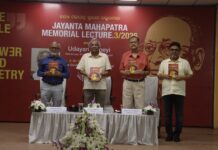
Bhima Bhoi has followed a minimalist approach in narrating Mahimā Dharma in four words, viz., nishkāma, nirbeda, satya, and dharma. His literary skill, Vedantic understanding, and empathy for people have made Stuti Chintamani indeed a jewel of thoughts offered to Shunya-brahma. This is a reason why Stuti Chintamani, with its hundred bolis, has made an indelible impact on the masses. The proposed Katha, in two volumes, presents an English translation of the bolis with a commentary for each.
(Excerpts from ‘Stuti Chintamani Katha’ translated and commentary by Hrushikesha Mohanty. With permission from publishers BK Classics/Bhubaneswar. Views Expressed are Personal)