




















A Book review of Raj Kumar Mohanty’s work revealing how old – age discoveries shaped today’s scientific world
Bhaskar Parichha
This is a fascinating book for the reason that the author takes the readers into bygone eras of mankind and explores their scientific knowledge and wisdom that serves as a blueprint for scientific and technological development in modern times.
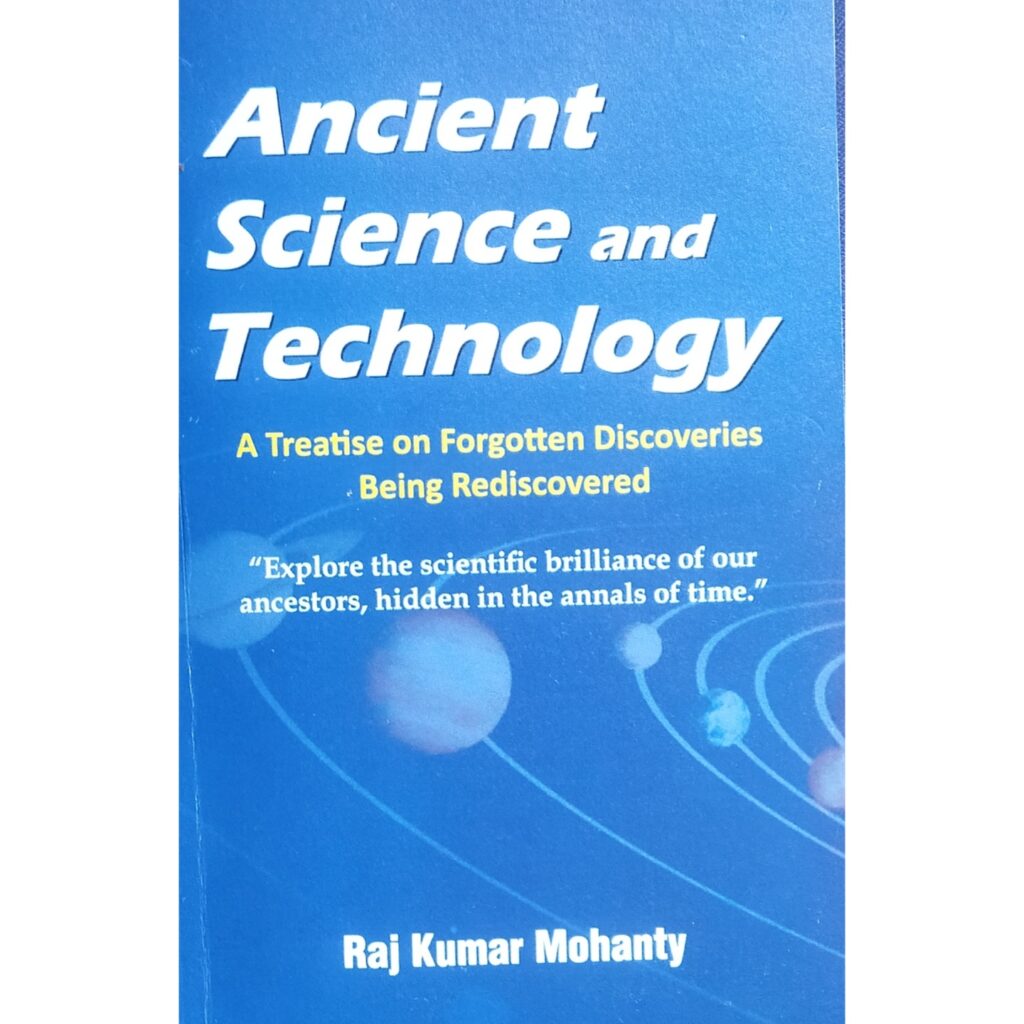
Ancient Science and Technology – A Treatise on Forgotten Discoveries Being Rediscovered by Raj Kumar Mohanty deals with everything ancient, yet has a modern relevance.
Mohant is a senior journalist who has been employed at a National English daily newspaper for the past thirty years. He has taken part in numerous National seminars and workshops focused on Indology and has delivered presentations on the topic.
From gravity and optics to sound, mathematics, astronomy, civil engineering, aviation, human fertilization, to genetics, this 250-page book unveils how the foundations of modern science were not invented anew, but most of them rediscovered from the depths of ancient wisdom.
In the Foreword, Houston-based independent consultant Dr Satyajit Verma writes: ‘For centuries, ancient knowledge – often viewed as mystical or theological in nature-has been relegated to the domain of legend. However, as archaeological discoveries and ancient manuscripts resurface, we are beginning to realize that the scientific achievements of ancient civilizations were far more advanced than we ever imagined. From astronomy and mathematics to metallurgy and medicine, ancient societies, particularly in India, developed sophisticated systems of knowledge that we are only beginning to appreciate.’
This book guides readers through historical narratives to reveal the origins of numerous disciplines, many of which were developed by ancient Indian scholars and practitioners. It delves into the wonders of astronomy, the notion of gravity, the principles of geometry, and early progress in genetics, all of which were identified long before the contemporary scientific era. The ancient texts, whether Vedic or non-Vedic, provide insights into the universe that harmonize spirituality with scientific exploration.
Writes Mohanty in the Epilogue, ‘Throughout history, civilizations have sought knowledge, not just to survive but to transcend the boundaries of the known world. The wisdom embedded in the Vedas, Puranas, Upanishads, the Bible, the Quran, the Avesta, the Tripitaka, and Jain scriptures demonstrates an intricate understanding of the universe, one that modern science continues to explore.’
‘The discoveries by the ancients on the fundamentals of scientific principles have now redefined our modern scientific and technological world. While modern advancements have refined. These theories, with precision, the essence of ancient knowledge remains indispensable. Knowledge is not a linear path but a vast continuum. Modern science could be said to have begun with Newton’s discovery of gravity in the 17th century. Great scientists like Dalton, Volta, and Thomas Alve Edison added to the list of inventions of electricity, chemistry, and light, thereby drawing humanity’s attention to the usefulness and necessity of science.
Undoubtedly, the findings of today resonate with the murmurs of history, serving as a reminder that education is perpetual, and science, in all its manifestations, stands as a testament to human inquisitiveness and tenacity.
This book is intended for a broad audience, including general readers, students engaged in graduate and postgraduate studies across diverse fields, as well as members of the scientific community for study and research.
(The author is a senior journalist and columnist. Views expressed are personal.)