















Donald Trump’s tariff war strained Indo-US ties, reshaping trade, geopolitics, and India’s foreign policy choices amid shifting global power dynamics
Suresh Chandra Sarangi
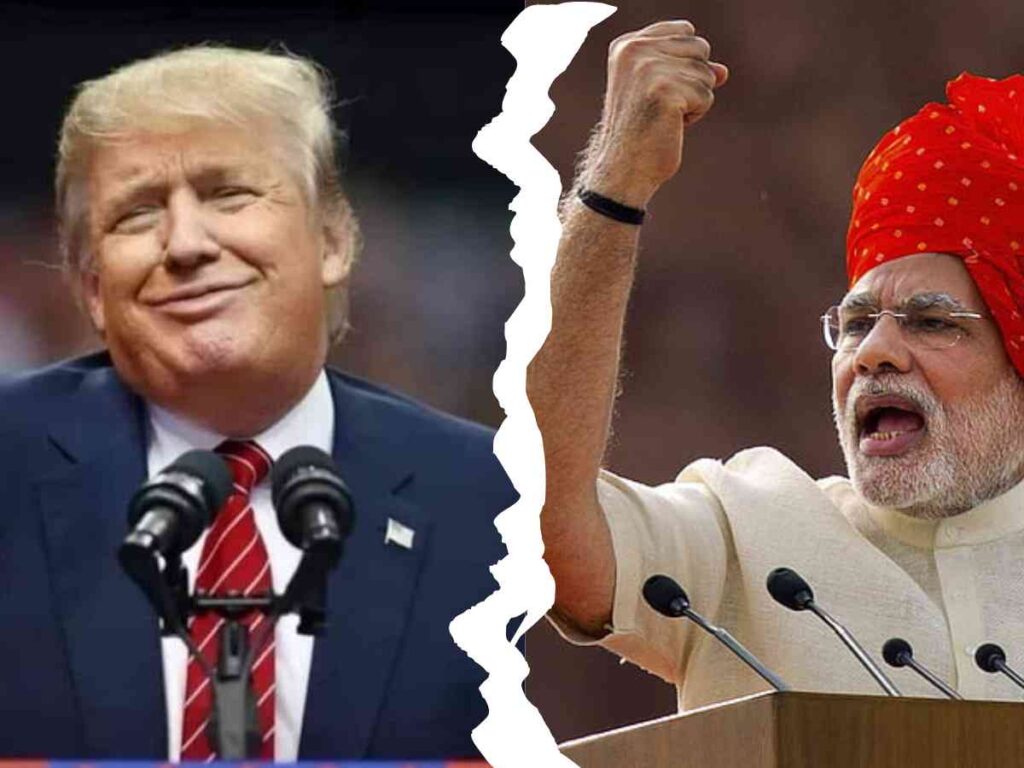
While India was trying to find its place in the world, some emerging as well as disturbing and concerning developments in the world, a virulent type of trade war unleashed by President Donald Trump has triggered a nadir in Indo-US relations. Day by day, almost for the last 1 month, the cordial relationship is ebbing. Some 25 years ago, India made the news in America, when a catastrophe occurred like the Bhopal gas tragedy, or the riots between the communities, or insurgency in Kashmir, The US media depicted India as a nation of snake charmers, saints and beggars, where existed faith and deprivation and India, therefore, was touted to be in an edge of chaos.
After the independence of India, the US and India shared some very common agendas like pluralism and Democracy. But Trump’s tariff war has estranged two like-minded partners in the polity of nations. One of the oldest civilizations, India was the leading economy before the arrival of the Mughals and then the British.
But today, the tide has reversed, it is the Fortune 500 companies that make a beeline before the Indian corporates to enhance their bottom line. There was a growing ambition and optimism about India’s global importance. However, Trump’s tariffs have created an autumn of discontent, and India’s efforts to establish itself as a consequential actor on the world stage, as the largest democracy and fastest-growing economy, have been insensibly disheartened by the politics of megalomaniac rhetoric.
White House press secretary Karoline Leavitt stated that the US president has taken several actions, including imposing a secondary tariff on India, to bring the war in Ukraine to an end. Secretary Scot Bessent argued for a smaller tariff on Beijing than that of India, over the issue of India buying Russian oil and thereby indirectly helping Russia in the war.
China, though purchasing Russian oil, has diversified its proceeds, and India is making a profit by selling the same low-price oil at a profit in the world market. This is the height of hypocrisy, as Beijing was Washington’s archenemy, and Peter Navarro’s” Death by China” had influenced Trump to start the trade war to silence China.
Before that, Navaro had already said that India, by purchasing oil from China, is indirectly supporting Russia to continue a bloody war. It is a very nasty development when America imposed sanctions against Russia, and yet the US and Other European Nations were purchasing oil and gas from Russia. This was a body blow to India, and at no point in time had US relations ebbed so much, whether India’s interference in the freedom movement of Bangladesh and liberating the country, or when the US imposed sanctions against the Pokhran nuclear test by India.
India, a country to more than 1.4 billion people, with youthful demographic dividend, with median age of 29, with a surging middle class, and evolving consumer class, the fourth largest in terms of gdp, was no more a relic of history, but most modern nation by its geography, it’s history, and it is strategic interest being a leading soft power, its technological prowess, is no more a regional player but emerged as a potential global player in world stage. Trump was very happy with India, and to make it emphatic, he announced that India and Modi are my best friends. But why then was the honeymoon short-lived?
Why Trump became so aggressive against India, and the mercurial president gives all alibis to provide a supporting hand to others. Was it geopolitics, was it BRICS, was it for the fact that Trump wanted India to acknowledge his role in mediating in the Indo-Pak War, that will help nominate him for the Nobel Prize for peace? What about centuries-old relationships? What about Quad, a game started by the US to present India as a bulwark against China in the Indian Ocean? The position is more mercurial like the mercurial president, whose words become shifting sands.
Trump’s economic policies are more transactional. Trump thinks that tax cuts and tariffs will make America great again. Tax cuts and tariffs may be instrumental in bringing domestic demand, but in the long run, they may result in inflation and rising costs. Will it reduce the unmanageable trade deficit in his own country? While analysing Indo-US relations, the past 25 years have been very fruitful in building the strategic ties between the two countries. But the carefully cultivated relationship has gone off the rails, and the rift is openly visible.
The present tariff rate, 25% now and 25% to be implemented later this month, is one of the highest among many countries and higher than its archenemy, China. As China holds approximately $800 billion in US treasury, and any withdrawal by China would threaten a bond market crash, bringing in a consequential adverse impact on America’s economy, Trump has now changed his strategy with China.
Trump is not relenting so far as India is concerned. India believes in the policy of non-alignment and therefore, it is not isolationism, but national interest that reigns supreme. New Delhi never wants any external mediation in its national or international affairs. India’s foreign minister S Jai Sankar spoke very befittingly, the calm truth, India will not take sides and protect its national interest. His message was a clarion call to the world leaders.
In the aftermath of Trump’s offensive and the ensuing tariff war, let us have a glance at India-US trade volume. During the fiscal year 2024-25, the bilateral trade was to the tune fs dollar 134 84 billion, making the US India’s largest trading partner. India exports to the US 88 billion and IS 45.7 billion. Trump was desirous of opening up India’s market for dairy products, soya, and other agricultural products, and PM Modi has objected to that as it will be inimical to the interests of Indian small farmers. Trump has protested that India provides a lot of subsidies, fertiliser subsidy, interest cut for farmers, for which their prices are competitive, while American home products are under pressure.
The rift seems to be widening. In the meantime, Prime Minister Modi is moving nations and searching the market to avoid any long-term effects. One of the greatest irritants in the mind of Trump was the appearance of BRICS on the horizon and the contemplation of bringing a BRICS currency. The dollar seems to be losing ground, and the dollar index today is 97 against 110, a few months before, and Trump’s apprehension is growing out of that.
In the meantime, the Trump-Putin meeting in Alaska to stop the Russia-Ukraine war has not yielded any results. Another round of talk with Zelensky is over. It is contemplated that a third round amongst Trump, Putin, and Zelensky may be in the offing. Trump wants his Nobel prize for ending the war, and once the tripartite understanding is inked, India may have no problem obtaining Russian oil.
It is shifting sands. Trade statement continuing. Years of cordial trade and international relations are buried under American protectionism. From the ramparts of Lalkilla, PM Modi spoke about the second generation of reforms, which has espoused interest in India. The markets seem to be buoyant in the last few sessions.
There is good rainfall. Standard and Poor’s has increased India’s rating on the eve of Independence Day to BBB from BBB, thereby indicating a stable economy. The PM is visiting China on the eve of the SCO summit. The Chinese delegation, led by the foreign minister, came to India and cordial bilateral issues, including the resolution of border skirmishes and trade decisions, are being addressed.
Later, President Putin will visit. India is trying hard to carve a niche market outside the US, aiming for diversification. The effect of Trump’s 50% Tariff has less of an effect in the short term. But analysts say it may have a negative impact to the tune of .5 percentage points. Moreover, its impact on the Rupee and India’s foreign exchange is discernible. Trump’s action has scant respect for India’s core foreign policy concerns, which is worrisome.
The two Titans are fighting an ideological war that may impact India. America’s foreign policy foundation towards South Asia seems to be shifting. The situation is being carefully watched and studied in India by the PM and foreign and trade policy experts. India, under no circumstances, appears to bend down on core issues and depend on its policy of national self-determination.
In the long run, Trump’s relative indifference to India in South Asia will invariably mean China may step in. But India, with its inherent strength, a booming economy, and strong GDP, shall do anything to be an emerging power, but not at the cost of national interest and national sovereignty.
(The writer is a former General Manager of Bank of India. Views expressed are personal.)
This article on Indo US relations in the recent past throws light on the paradigm shift in the foreign policy of USA under the leadership of Donald Trump,who has been widely described as extremely unpredictable.Trump’s tariff war against India vis a vis China has raised many eyebrows all over the world.As has been rightly observed, India has stood its ground by not being cowed down vy the US threat of imposition of higher tariff back to back,taken a resolve to face the consequences and tide over the crisis by adopting its own strategies of foreign trade and re-aligning its foreign relations.A nicely written article by all standards.