



















Discover Cuttack’s iconic Durga Puja with its silver Chandi Medhas, centuries-old traditions, and cultural grandeur that rivals Kolkata’s celebrations
Raja Parija
In colloquial parlance, the 1000-year-old city of Cuttack is often referred to as a city with “Baban Bazar, Teppan Galee”, meaning the city of 52 markets and 53 streets. Every Odia kid, when they start to learn the Odia alphabets, must go through the “Odia Barnabodha,” the bible, to learn Odia. After completion of the alphabets, the first Odia sentence he or she writes is “Kataka Nagar Dhabala Tagar” That is why Cuttack has always remained in the hearts of every Odia in the state and abroad.
Established in 989 AD, the city has gone through a massive transformation during the last 50 years. The city landscape has undergone tremendous change and grown much beyond one’s imagination. It has grown from a small place to a metropolis with a population of more than 12 lakhs. In fact, the city is growing every day.
The most interesting aspect that makes Cuttack unique is its secular characteristic of peace. which is accepted generation after generation. That is why it is often referred to as “Bhaichara ra Sahara,” the city of brotherhood. The core concept of tolerance for diversity has remained intact over the centuries. The city’s secular fabric and cosmopolitan culture attract people from all over the country. The peaceful co-existence of all faiths is also reflected in the crafts and cultural ethos-in form, symbolism, and aesthetics.
Cuttack, though one of the important Sakti Pithas of Odisha since time immemorial, the history of celebrating Durga Puja, ie, the present form of worshipping of “Mrinmayee Murti” (clay idol of goddess Durga), goes back to the 16 century. To be honest, whenever it comes to the celebration of the Durga Puja festival, everybody talks about Kolkata. But very few people know that the celebration of this festival in the 1000-year-old city of Cuttack is much older than that of 300-year-old Kolkata. Durga Puja in Cuttack is not just a festival of devotion and fun, it is a grand economic affair involving transaction crores of rupees and creating opportunities for hundreds of skilled and unskilled people.
In the 1980s, Cuttack was popularly known to the outside world for three reasons: breath-taking “Tarakasi Kama” (silver filigree art), Durga Puja, or Dussehra festival, and iconic street food, “Dahibara-Aloodum”. And the city still preserved its legacy. In those days, the Durga Puja festival, though celebrated throughout the state as one of the major religious festivals, Cuttack was its epicentre. It is celebrated here with much pomp and show, The Choudhury Bazar Puja Mandap, which introduced the first Chandi Medha (silver filigree tableau) in 1956, was the centreof attraction and was drawing huge crowds from all parts of the state and neighbouring states.
In the meantime, a lot of water flows into the river Mahanadi and its tributaries, Kathajodi, Kuakhai, and Birupa. The mode of puja celebration in Cuttack has undergone a sea change. By the year 1947, it was celebrated only in 47 localities; now it has reached about 200. Similarly, the majestic Chandi Medha has increased from only one in 1956 to an elite club of 32 in 2023. Every year, a new Chandi Medha comes up. Apart from the gold and silver filigree jewellery of the deities, the massive Chandi Medhas are 20 to 25 feet high, weighing about 1 to 6 quintals of pure silver. In its true sense, the puja is celebrated on a grand scale with all its grandeur. People from across the country and even from abroad visit the city during the Durga Puja to catch a glimpse of the Odia craftsmen’s magic reflected in gold and silver filigree work. Although Kolkata is famous for celebrating Durga Puja by erecting lavish Puja Pandals with elaborate decorations and dazzling illumination, Cuttack celebrates the Puja in style with a silvery touch of world-famous filigree art. In fact, the Chandi Medhas of Cuttack showcase a sparkling aura.
It took nearly six years to document this volume, as the author had to go through related books and journals, visit Sakti pithas of the state and each Puja Mandap of the city, discuss with the members of Puja committees, and finally visit filigree workshops to have first-hand knowledge about the making of Chandi Medha. The most difficult part of documentation work was photographing Chandi Medhas, as the author had to take photographs only on Shasti Puja day because once the Puja starts, the idols are decorated with flowers and garlands that cover the intricate details of the Medhas. That is why it took six long years to photograph all the Chandi Medhas of the city.
The Durga Puja celebration in the millennium city of Cuttack is much more spectacular than the Durga Puja of Kolkata, the Dusshera festival of Mysore, the Ganapati festival of Mumbai, or the Christmas celebration of Goa. But unfortunately, it is yet to get the much-deserved attention of UNESCO and be included in the prestigious list of “UNESCO Intangible Cultural Heritage.”
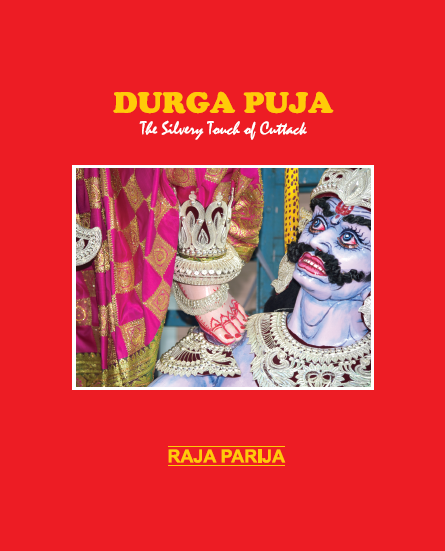
This volume comprehensively gives a graphic picture of the eight-hundred-year legacy of the Durga Puja in Cuttack. The readers will find this work of great value. This is the 4 book on millennium city of Cuttack by the author after “Silver Splendour of Millennium City”, “Netaji was born here” and “Cuttack-The city of museums.”
(The author is an art Historian. Excerpts from the book ‘Durga Puja -The Silvery Touch of Cuttack’ by Raja Parija and published by Pagemaker Publications)