




















Explore Chicago’s journey from prairie lands to the birthplace of skyscrapers in Trailokya Jena’s travel chronicle, Journey Across the Americas
Trailokya Jena
I halted at Milwaukee specially to visit the Harley Davidson factory and Museum and shall explain a few things on the photos separately posted. I did not go to Detroit this time for I have visited it in the past when it was in far better shape. I only drove up to Kalamazoo, a halfway point between Chicago and Detroit to save myself the squalor and degradation of the motor city of yore. Instead, I’d like to concentrate here on Chicago, one US city I love alongside San Francisco, Philadelphia, Boston and somewhat grudgingly New York.
Chicago’s is a relatively late entry into the American geographical and economic system. At the turn of the 18th century when most of the east coast of America was taken over by Europeans, Chicago was just a vast tract of unspoilt prairie land sitting next to a large freshwater lake, an area home to native tribes for thousands of years. The French were the first to arrive late into the 17th century.
Like elsewhere in the continent, native tribes got into conflict amongst themselves competing over the fur trade with white men. The French took advantage to move in and created organised settlement under Jean Baptist Point du Sable, a Frenchman of African descent. The French called this new settlement ’chicagoua’ believed to be based on the native name for the wild garlic that grew abundantly in the area.
The local tribes that lived on hunting and fishing had good relation with the French all along. In spite of that amicable coexistence, they were forced to sign in 1789 their first land treaty with the Europeans. Gradually the tribes kept on losing land like everywhere in America and by late 19th century had to recede entire control by ceding nearly 90 million acres of land to Europeans. Chicago had a mere 4000 population when it was officially incorporated as a city in 1837.
But it grew rapidly for various geo economic advantages it derived from its location. By 1848, the Illinois and Michigan Canal had been completed to link the Great Lakes to Mississippi River system. Chicago was ideally situated to take advantage of the trading possibilities created by the nation’s westward expansion.
The settlements that came up through these expansions needed supplies which Chicago was ideally placed to provide first through river boats/ steamships and later by railroads. Chicago quickly grew up as a boomtown. By the time the great fire struck the city in 1871, its population had reached nearly 330,000 with people living in the most crammed and unhygienic environment.
The great tragedy of the fire proved to be an opportunity for the city as the complete destruction allowed it to be rebuilt in an organized manner. New scientific and engineering technique developed by the time offered full advantage for the purpose. Chicago rebuilt quickly. Much of the debris was dumped into Lake Michigan as landfill, forming the underpinnings for what is now Grant Park, Millennium Park and the Art Institute of Chicago. Only 22 years later, Chicago celebrated its comeback by holding the World’s Columbian Exposition of 1893, So much so that Chicago is the city that gave rise to the phenomenon of skyscrapers.
Chicago is considered the birthplace of the skyscraper with construction of the first one, the Home Insurance Building, completed in 1885. This building was the first to use a steel skeleton frame, which allowed for unprecedented vertical growth by using a metal frame to support the entire structure. Before this, buildings relied on their outer walls for support, limiting their height to just a few stories.
The development of steel frame construction, pioneered by Chicago architect William Le Baron, was crucial because it allowed architects to build taller buildings with large windows that were both safer and more practical. It also allowed measures to counter the strong winds the city traditionally encounters.
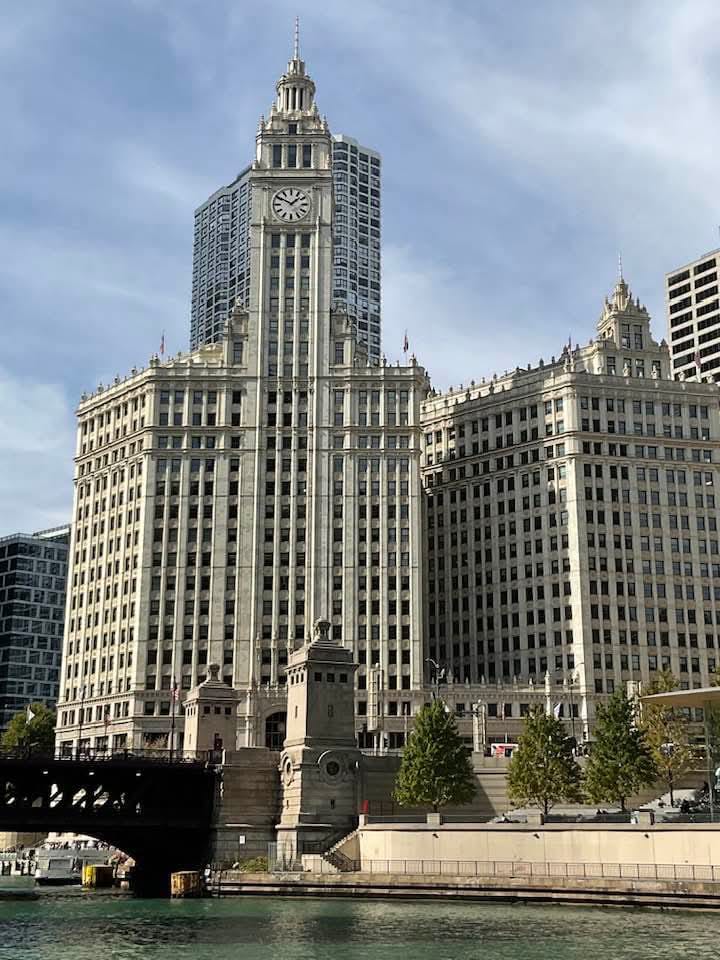
Besides, steel based engineering technology helped building strong bridges across its rivers and canals allowing construction of taller buildings catering to the growth of the city’s central business district. Two of the iconic buildings that came up as marvels of modern architecture are the Wrigley Building (of the chewing gum fame) with its iconic clock on its white terracotta facade and the Tribune Tower of the Chicago Tribune newspapers, both on North Michigan Avenue.
(Born in Cuttack, the author is a historian, traveler, and a former Income-Tax Commissioner)