























Exploring the essential facets of child psychology and parenting through the lens of one of world’s greatest intellectual expErts
By Nilambar Rath
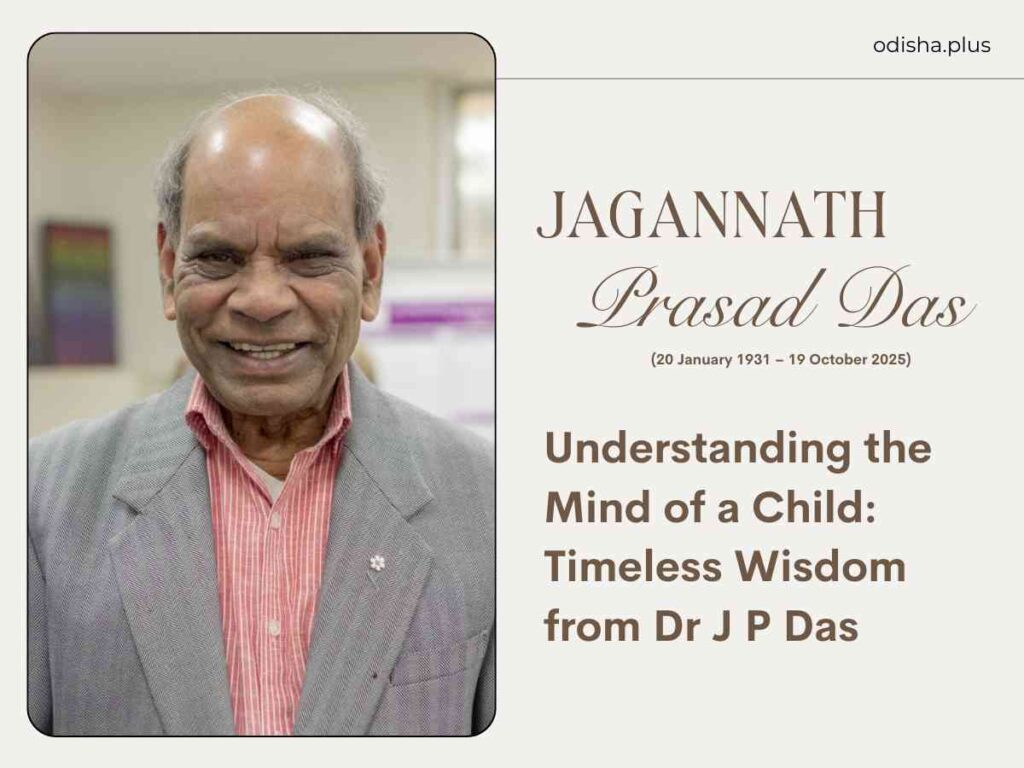
Dr. Jagannath Prasad (J.P.) Das was one of the finest psychologists with global recognition who was born in Odisha and started his early career as a faculty at Utkal University, Bhubaneswar. An internationally acclaimed psychologist and Professor Emeritus at the University of Alberta, Canada, his work has left an indelible mark on the field of child development.
In a rare and insightful series of short videos recorded in Bhubaneswar in 2012 by OdishaLIVE, Dr. Das distilled decades of research into practical wisdom for parents and educators. These videos, part of the series ‘Dealing with Children’, serve as a vital guide for anyone looking to navigate the complex journey of raising a child.
The Early Years: Beyond the First Five
While common wisdom emphasizes the importance of the first five years of a child’s life, Dr. Das encouraged a more nuanced observation during this “vital period”.
- Spotting Potential: He highlighted the need for early recognition of “giftedness and talent” in children.
- Early Intervention: Simultaneously, he stressed being aware of any mental or physical developmental problems as early as possible.
- Navigating Diversity: Dr. Das noted that children must learn to relate to a diverse world, including peers from different social classes, linguistic backgrounds, or single-parent families.
The Shift in Social Attachment
One of the most profound observations Dr. Das shared involved the natural transition of a child’s social circle, which often catches parents off guard.
- The Parental Phase: Young children often feel that their parents do not spend enough time with them.
- The Peer Phase: By age 10 or 11, the “most important people” in a child’s life shift from parents to their friends.
- The Teenage Transition: By the age of 13 or 14, the attachment to peers is usually complete.
- The Regret Loop: Dr. Das pointed out a common irony: while young children want more “FaceTime” with parents, by the time they are teenagers, it is the parents who often regret not seeing enough of their children.
Rethinking Early Education
Dr. Das held strong views on the “mechanical” way children are often taught in modern society, particularly in the Indian context.
- The Writing Trap: He argued that teaching writing too early—especially in multiple languages—can be “suicidal” for a child’s natural intellectual development.
- Prioritizing Understanding: He believed children should first become familiar with the alphabet and numbers before being forced into the mechanics of writing.
- Collaborative Learning: Learning should not be a lonely task with a tutor in a small room; instead, it should happen through collaboration and interaction with others.
Managing the Digital World
Even in 2012, Dr. Das was prescient about the impact of media consumption on the middle-class urban child.
- Establishing Rules: He advocated for firm household rules, such as limiting TV or screen time to two hours a day.
- Monitoring Content: Parents must remain vigilant against content depicting violence or abuse to protect a child’s psychological well-being.
- The Power of Distraction: Rather than a hard “no,” he suggested using distraction to steer children away from inappropriate content toward healthier activities.
A Global Legacy with Odia Roots
In the journey of his prolific career, Dr. J.P. Das also joined in his intellectual pursuits by his spouse, Gita Das, a noted psychologist. Together, they authored many publications in various languages, including their native Odia, making complex psychological concepts accessible to a wider audience.
Dr. Das was not just a scientist of the mind; he was a bridge between the clinical world of psychology and the everyday reality of the family unit. His teachings, preserved in the archives of OdishaLIVE, continue to offer a roadmap for understanding and celebrating the “uniqueness” of every child.
The OdishaLIVE Family pays a deep and heartfelt tribute to this great soul—a global giant in psychology and a truly loving son of the soil.
Brief Bio: Jagannath Prasad Das (20 January 1931 – 19 October 2025) was an Indian-Canadian educational psychologist who specialised in educational psychology, intelligence and childhood development. Among his contributions to psychology are the PASS theory of intelligence and the Das-Naglieri Cognitive Assessment System. Das was the Director of the JP Das Developmental Disabilities Centre at the University of Alberta. He formally retired in 1996 and was an Emeritus Director of the Centre on Developmental and Learning Disabilities and an Emeritus Professor of Educational Psychology at the University of Alberta. He was a member of the Royal Society of Canada, he was also inducted into the Order of Canada[1] and has an Honorary Doctorate degree from the University of Vigo in Spain.[2] (Brief Bio Source: Wikipedia)
(About the Author: Nilambar Rath is a senior media personality and communication strategist with over three decades of experience across print, TV, and digital media. He is the Founder Editor & CEO of OdishaLIVE Media Network and a dedicated advocate for development communication and Odia culture.)