



















Odisha has emerged as a leading model in mangrove restoration, combining science, policy support, and community participation. Its mangrove cover has increased by 16.6%, strengthening coastal resilience, livelihoods, and biodiversity
OdishaPlus Bureau
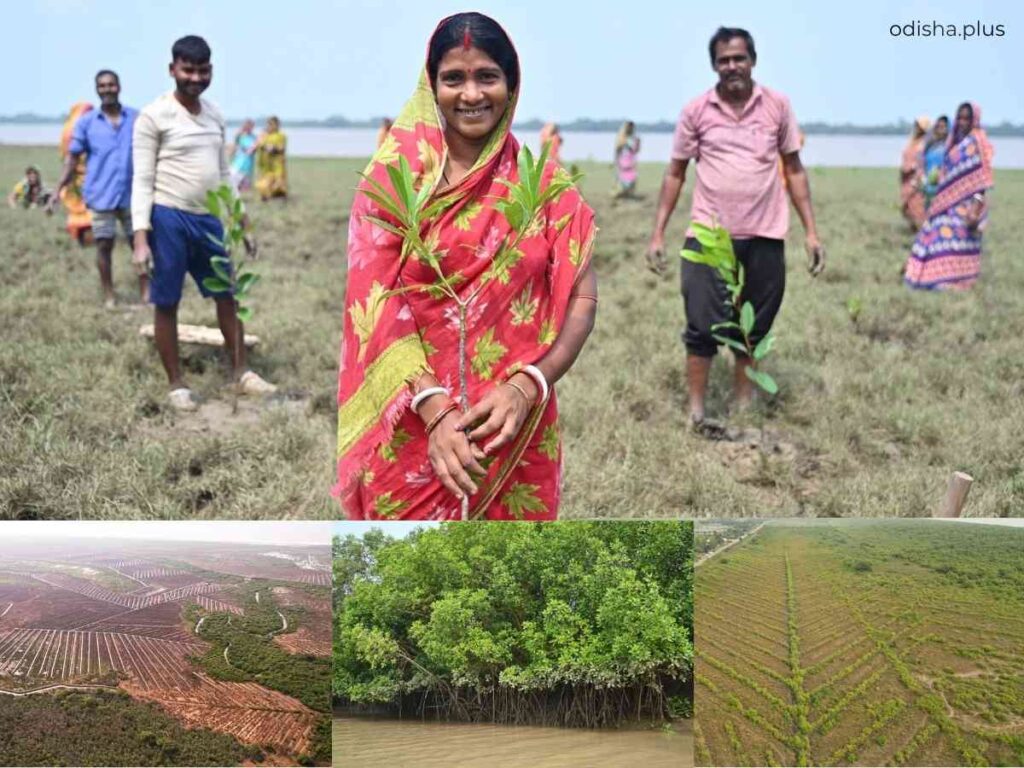
- Mangrove forest cover in Odisha has increased by 16.6%
- Bhitarkanika National Park has largest mangrove area, covering over 212 sq km
- Innovative steps taken for sustainable restoration and conservation of mangroves
- Special programs implemented with community participation and support from CAMPA
Odisha is establishing itself as one of India’s most successful models in mangrove restoration, delivering measurable ecological, economic, and climate outcomes at scale. Today, the State hosts approximately 259.06 sq. km of mangroves across five coastal districts, with Bhitarkanika National Park in Kendrapara district alone accounting for over 212 sq. km, making it one of India’s most significant mangrove ecosystems.
Anchored by scientific innovation, policy convergence, and strong community participation, Odisha has transformed its coastal ecosystems into resilient green barriers against climate change. With support from the Compensatory Afforestation Fund Management and Planning Authority (CAMPA), the State continues to scale coastal conservation initiatives under the vision of the Forest, Environment and Climate Change Department, Government of Odisha.
A key strength of Odisha’s approach lies in integrating science-driven monitoring with on-ground restoration. Data buoys deployed by National Centre for Sustainable Coastal Management (NCSCM) under Odisha Forestry Sector Development Project (OFSDP) play a crucial role in maintaining ecological balance necessary for growth of mangrove ecosystems in Bhitarkanika. These data buoys help detect pollution and environmental stress, enabling timely interventions and strengthening long-term restoration and conservation strategies.
“Financial support from CAMPA has been instrumental in scaling up these interventions. Beyond plantation, efforts have focused on ecological restoration measures such as creek deepening to restore natural tidal flow, and targeted fencing to reduce anthropogenic pressure,” said Varadaraj Gaonkar, Divisional Forest Officer (DFO), Mangrove Forest Division (Wildlife), Rajnagar.
Odisha is also advancing innovative restoration methods like the “fishbone channel” model, introduced to revive degraded tidal zones. By restoring natural tidal water flow, this technique has helped regenerate around 100 hectares of mangroves in just four years in Bhitarkanika.
The State’s approach goes beyond plantation, focusing on landscape-level restoration. Mangrove vegetation is concentrated across Kendrapara, Jagatsinghpur, Puri, Bhadrak, and Balasore districts. Over the past four years, mangrove cover in Kendrapara district alone has increased by approximately 9.43 sq. km, while for the entire Odisha it has surged 9.89 sq. km, according to India State of Forest Report (ISFR) data. Degraded mangrove patches, encroached government lands, and areas previously used for brackish water aquaculture have been successfully restored, reversing decades of ecological damage and reclaiming vital coastal habitats.
Another defining feature of Odisha’s model is strong community integration. With CAMPA-backed initiatives, local communities actively participate in nursery raising, plantation drives, and protection of restored ecosystems. This ensures conservation is closely linked with livelihood generation and climate resilience.
“Community participation has been central to our success. Local residents actively engage in plantation activities, fostering a strong sense of ownership. Improved ecosystem health has also supported livelihoods indirectly, particularly through fisheries and related activities,” affirmed the DFO, Rajnagar.
The impact of these efforts is already visible on the ground. “Earlier, high tides would send floodwaters surging into our village, destroying roads, inundating homes, and even bringing crocodiles along with the currents. Now the situation has improved significantly, bringing new hope and security for the community,” shared Uma Rani Giri, a resident of Kanaknagar village under the Rajnagar Forest Division.
Mangroves in Odisha are not just forests—they serve as critical bio-shields against cyclones and storm surges in a state frequently exposed to extreme weather events. Their dense root systems absorb wave energy, reduce coastal erosion, and stabilize shorelines. At the same time, they contribute to carbon sequestration, support biodiversity, and strengthen fisheries, thereby enhancing coastal livelihoods and food security.
“CAMPA has been supporting broader habitat restoration and scientific wildlife management across the Bhitarkanika landscape, ensuring a more holistic and sustainable approach to ecosystem conservation,” underscored the DFO.
Notably, over the last decade, Odisha has recorded a 16.6% increase in mangrove cover, expanding from 222 sq. km in 2011 to over 259.06 sq. km in 2023, as per ISFR data. This sustained progress reinforces Odisha’s position as a national leader in climate action, ecological governance, and nature-based coastal resilience.