























Monalisa Dash Dwibedy analyzes the historic BJP victory in West Bengal, the challenges of post-election violence, and the road to a peaceful democratic transition
Monalisa Dash Dwibedy
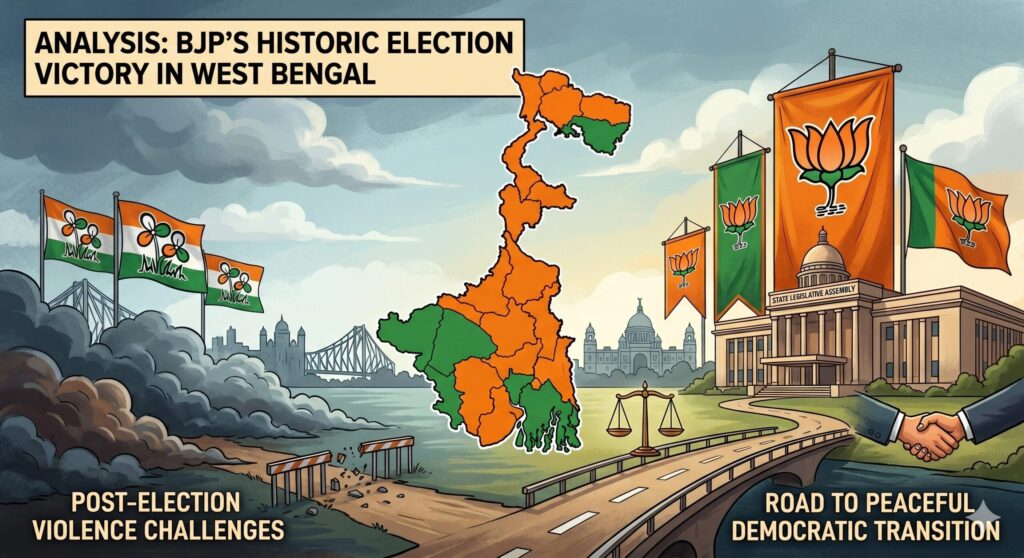
The recent electoral victory of the Bharatiya Janata Party (BJP) in West Bengal marks a historic political shift in a state long governed by the All India Trinamool Congress (TMC). Yet, instead of a smooth democratic transition, the aftermath has been marked by reports of violence, recrimination, and deepening mistrust. At moments like these, it is essential to separate verified facts from political rhetoric and focus on what truly matters: the safety of citizens and the integrity of democratic institutions.
Post-election violence has, unfortunately, been a recurring feature of politics in West Bengal, and this year appears no different, with reports from multiple districts indicating clashes between rival party workers, incidents of intimidation, and, in some cases, loss of life and property. What is particularly concerning is that such violence tends to occur at the local level, often fueled by long-standing rivalries, competition for influence, and the sudden disruption of established political networks following a change in power.
In the wake of the results, leaders from the TMC, including Mamata Banerjee, have alleged electoral irregularities and accused the BJP of vote-stealing, while BJP leaders, including Narendra Modi, have emphasized the legitimacy of the constitutional mandate and, in turn, accused their opponents of inciting unrest. Such exchanges are not unusual in a polarized political environment; however, when news media reports on these developments, the language and factual accuracy of the content become crucial. Sweeping accusations against entire political organizations risk inflaming tensions further, especially in a climate where misinformation can spread quickly. When narratives harden without verification, they deepen divisions on the ground, making reconciliation more difficult and potentially triggering more violence, which is why the media must ensure that reporting remains factual and avoids amplifying unverified claims.
With victory comes responsibility, and the BJP, as the incoming ruling party, bears a particular obligation to ensure that law and order is firmly maintained, reassure all communities, including political opponents, and demonstrate that governance will be inclusive and impartial, because a peaceful transition is not merely procedural but a test of democratic maturity.
Given the scale and sensitivity of the situation, the role of national leadership is equally critical, and as Prime Minister, Narendra Modi must ensure that adequate law enforcement resources are deployed promptly and effectively to prevent further escalation, including supporting state mechanisms where necessary, reinforcing security presence in sensitive areas, and sending a clear message that violence will not be tolerated under any circumstances, since visible and decisive action at this level can help restore public confidence and deter further unrest.
At the same time, the TMC, now in opposition, has a crucial role to play in exercising restraint in public statements, cooperating with lawful investigations, and encouraging supporters to avoid confrontation, because a healthy democracy requires not only a responsible government but also a constructive opposition. Institutions such as law enforcement agencies and the Election Commission of India must act swiftly and transparently, ensuring that investigations into incidents of violence are independent, time-bound, and free from political interference.
The people of West Bengal have delivered a decisive verdict, and what they deserve now is peace, stability, and governance that rises above partisan conflict; moments of political transition often test the resilience of democratic systems, and how West Bengal navigates this period will not only shape its immediate future but also serve as a broader reflection on the strength of India’s democratic fabric.
The path forward is clear: accountability over blame, evidence over rhetoric, and calm over confrontation.
(The writer is an IT Consultant living in Toronto. Views expressed are personal.)

The post poll violence erupted following the BJP’S winning debut in WB Assembly Election belie peaceful transition of power . It will be an ominous beginning for the BJP and a great disappointment for the people who voted for a change. Added to this Chief Minister Mamata Banerjee’s refusal to resign may lead to legal battle. After the swearing in ceremony of the new BJP Government there is likely to trigger further violence between the supporters of BJP and TMC .