





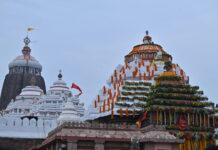


















Discover Old Town Bhubaneswar, the temple city’s sacred heart, where ancient shrines, rituals, and legends keep Odisha’s divine heritage alive
Dharma Raj

Long before Bhubaneswar rose as a planned capital of avenues and ministries, it was a forest of temples, a sacred grove known as Ekamra Kshetra—the “Mango Grove Area” of legend. Here, faith found form in stone, and the divine took residence in spires that still dominate the skyline. This is Old Town, the city’s historic heart, where time folds upon itself and the past breathes in the cadence of temple bells and conch shells at dawn.
Spread across roughly five hundred hectares, encompassing the ancient villages of Lingaraj, Kapileswar, and Goutam Nagar, Old Town remains a living heritage zone—dense with over five hundred temples, sacred tanks, monasteries (mathas), and dharamshalas. Its narrow, winding lanes have witnessed over two thousand years of uninterrupted worship.
Every morning, priests and pilgrims move along paths worn smooth by centuries of devotion, while incense curls into the sky above shrines carved with gods, dancers, and mythic beasts.
The story of Old Town begins in the 3rd century BCE, when this land was part of the powerful Kalinga kingdom—a realm forever immortalized by the Battle of Kalinga, which transformed Emperor Ashoka from warrior to apostle of peace. The temples that now define its skyline, however, belong to the 7th to 13th centuries, when Shaivism flourished under successive dynasties.
Here, the Kalinga style of architecture reached its purest expression—temples rising like stone lotuses, crowned with curvilinear towers (deuls) and covered in sculptures so intricate that light itself seems to dance upon them.
For centuries, this was a seat of pilgrimage and culture. Even after the decline of the Bhoi dynasty in the 16th century, and the arrival of Maratha and British rule, Old Town retained its sacred rhythm.
When Otto Königsberger, the German architect, was commissioned in 1948 to design modern Bhubaneswar as Odisha’s new capital, he placed it beside the ancient one—leaving Old Town to preserve the city’s spiritual and artistic soul. The contrast remains striking: the rational order of the planned capital meets the labyrinthine poetry of the sacred city.
Old Town is a temple-lover’s paradise, where Lord Shiva presides as the eternal guest of honour. The grandest of all is the Lingaraj Temple, an eleventh-century masterpiece dedicated to Shiva as Tribhuvaneswar. Its towering spire commands the horizon, its massive compound alive with ritual and devotion. Non-Hindus cannot enter, but even from the outside, the temple’s sheer scale and sculptural richness inspire awe.
A few steps away lies the shimmering expanse of the Bindu Sagar Tank, encircled by shrines and cloaked in myth. It is said that the waters here contain drops from every holy river in India. During the Chandan Yatra festival, the deities sail across the tank in ceremonial boats, their reflections rippling across the surface like fragments of ancient hymns.
The Mukteshwar Temple, often hailed as the “Gem of Odisha Architecture,” glows with quiet perfection. Built in the tenth century, it is delicate rather than grand—its graceful arches, lattice windows, and the famed torana gateway marking a turning point in temple design.
Nearby, the Rajarani Temple tells a different story. Built in the eleventh century and now devoid of a presiding deity, its walls pulse with sensual carvings of dancers, musicians, and lovers, echoing the spirit of Khajuraho.
Older still is the Parashurameswara Temple—seventh century, compact and richly detailed—one of the earliest examples of the Kalinga idiom. Close by stands the Brahmeswara Temple, built by a queen in honour of her father in the eleventh century, its outer walls alive with scenes from mythology.
The Sivatirtha Matha, a nineteenth-century monastery, still pulses with life, especially during Dola Purnima, when Lord Lingaraj is believed to visit for a symbolic feast with his devotees. Amid this predominantly Shaivite landscape stands a unique exception—the Ananta Vasudeva Temple, a thirteenth-century Vaishnavite shrine housing the only active image of Krishna in Bhubaneswar.
Beyond these stand quieter sanctuaries—Megheswar, Kedar Gauri, Rameshwar—each an echo of a bygone age, each still vibrant with the rhythm of prayer. During Maha Shivratri, Old Town transforms into a living festival. Lamps flicker on the water, chants rise through the night, and the ancient streets turn into rivers of devotion.
Amid this sacred mosaic, life carries on in ordinary grace. To walk these streets is to experience not a museum, but a living city where the sacred and the mundane coexist effortlessly. Heritage walks curated by Odisha Tourism now guide visitors through this labyrinth of faith, revealing stories that blur the line between myth and memory.
Yet, like many ancient quarters, Old Town faces modern anxieties—unplanned growth, urban encroachment, and the pressing need for conservation. But for now, it endures.
The chants still rise with the dawn, the temples still gleam after the monsoon rain, and the gods—one feels—still walk these streets.