













A century of Gandhi’s ‘My Experiments with Truth’ reflects his journey of truth and nonviolence. A tribute in Window Seat with insights on culture and society
Mrinal Chatterjee

100 years of ‘My Experiment with Truth’

Mahatma Gandhi’s autobiography was written and serialized over the period from 25 November 1925 to 3 February 1929 in 166 instalments, which appeared in Navajivan (Gujarati). It was titled ‘satyanā prayogo athavā ātmakathā (‘Experiments of Truth or Autobiography’). It covered his life from early childhood through to 1921.
The corresponding English translations were printed in Young India, and reprinted in Indian Opinion in South Africa, and in the American journal Unity. The Hindi translation was published almost simultaneously in the Hindi edition of Navajivan.
Mahatma Gandhi’s autobiography is not merely a retelling of events in his life; it is a philosophical and moral journey into the making of a global icon of nonviolence, human dignity, and ethical living. It traces the evolution of his thoughts, convictions, and ideals. What makes this work especially compelling is Gandhi’s tone of humility: he never presents himself as a hero, but as an ordinary man struggling toward truth through trial and self-reflection.
The central theme of the book is the concept of truth—not as an abstract principle, but as a lived practice. Gandhi believed truth to be inseparable from morality and personal integrity. Throughout the autobiography, he describes truth as something to be pursued through experimentation: testing oneself through diet, celibacy, honesty, service, and self-discipline. He treats his life as a laboratory of ethical experiments, some successful and others contradictory or even painful. This radical self-honesty gives the text unusual authenticity.
Equally significant is Gandhi’s exploration of ahimsa (nonviolence), which he portrays as a natural companion to truth. The seed of nonviolence, he suggests, was planted early in his life by his mother’s spiritual influence and later nourished by Hindu, Jain, and Christian teachings. His experiences in South Africa—where he confronted racial discrimination and organized the Indian community politically—were instrumental in shaping Satyagraha, his method of peaceful resistance based on moral force rather than physical aggression.
Gandhi’s account of his internal struggles—over diet reform, brahmacharya (celibacy), fear, ego, and social reform—reveals not a saintly figure, but a real human being attempting to cultivate purity of thought and deed. He writes with disarming candour, admitting to mistakes, doubts, and weaknesses. This honesty allows readers to see how personal discipline and moral growth underpin his public actions.
The significance of My Experiments with Truth lies not only in its historical value but also in its continuing relevance. In a world troubled by violence, inequality, and moral confusion, Gandhi’s insistence on ethical living, compassion, and steadfast commitment to truth provides an enduring moral blueprint. Rather than imposing his values, Gandhi invites readers to undertake their own experiments—to find truth through self-examination and a life of integrity.
The autobiography stands as a testament to Gandhi’s belief that social change begins with personal transformation.
‘How India Eats’

I just went through the highlights of the 2025 edition of Swiggy’s annual report, ‘How India Eats’.
It projects that India’s food services market will surpass $125 billion by 2030.
That may or may not be good for society, but this one is definitely worrisome: Late-night dining (meals beyond 11 PM) is growing at an alarming rate. And people are preferring pizzas, cakes, and soft drinks for dinner. That is a sure shot recipe of obesity and diabetes.
Nandalal Bose
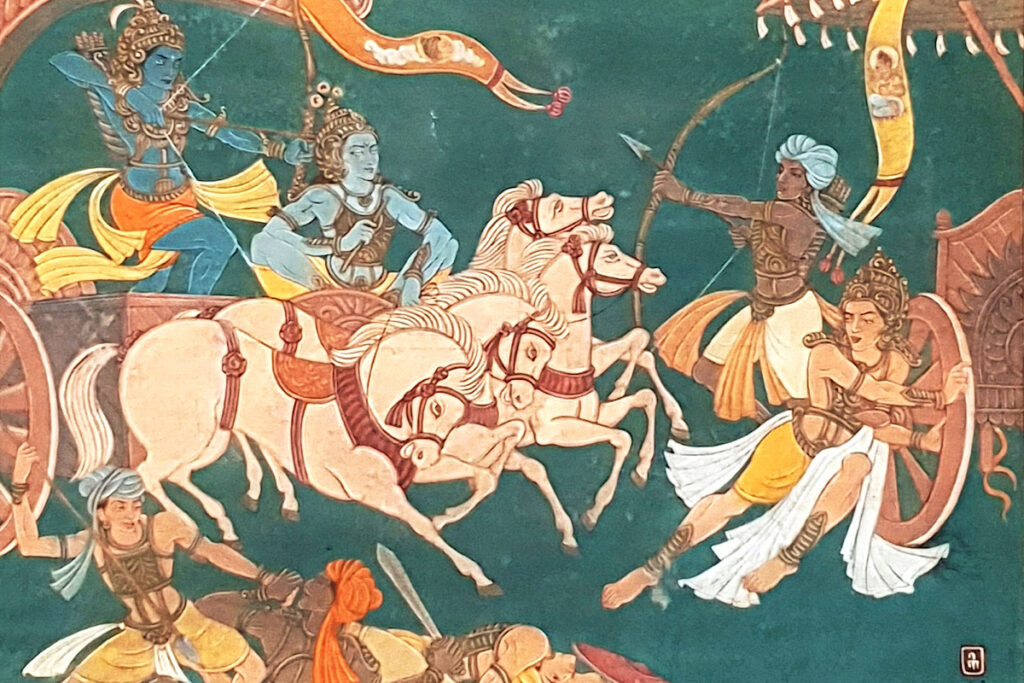
December 3 was the 143rd birthday of Nandalal Bose, one of the pioneers of modern Indian art and a key figure of Contextual Modernism. A pupil of Abanindranath Tagore, Bose was known for his “Indian style” of painting. He became the principal of Kala Bhavan, Santiniketan in 1922.
He was a key figure in the Bengal School of Art and developed artistic styles influenced by traditional Indian forms and Japanese art.
The Indian Constitution has his unique artistic touch. He was leading the team of artists who illustrated its original, handwritten manuscript. He personally designed the emblems for high national awards like the Bharat Ratna and PadmaShri; and directed his students from Santiniketan to create elaborate artwork for each page, blending traditional Indian artistic styles with modern aesthetics to represent the nation’s rich heritage.
He died on 16 April 1966 at the age of 83 years.
Morning Walk
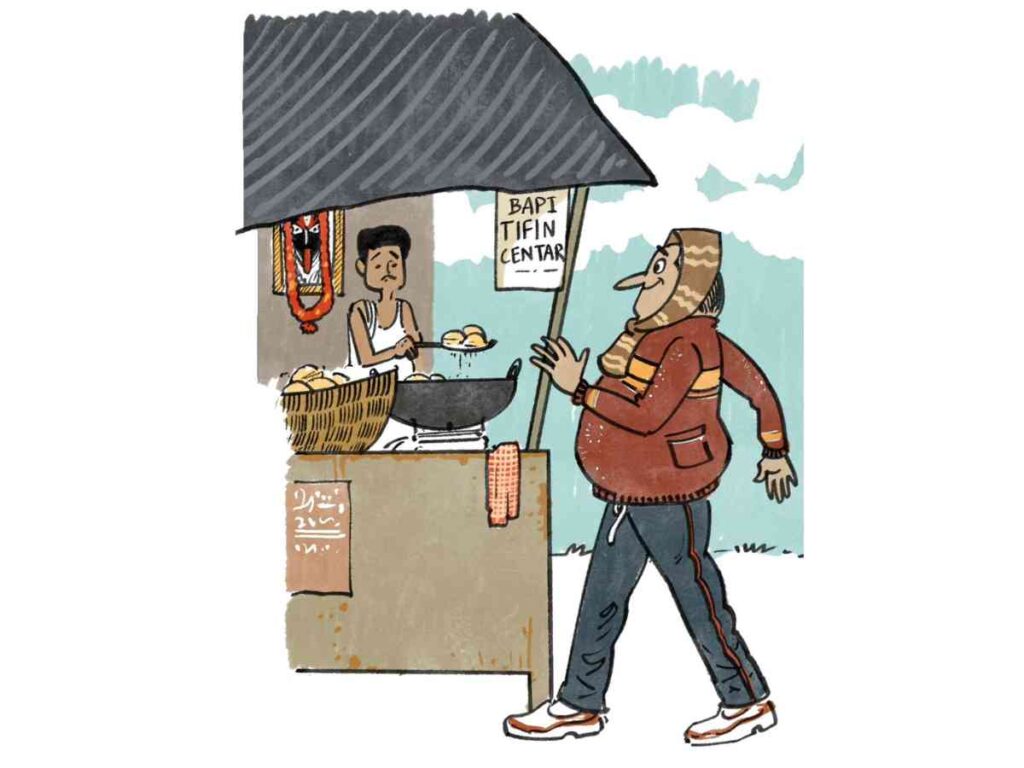
I found the real reason many of us oldies go on a morning walk without their spouses: the tasty roadside snacks. I had always suspected this; now my friend JP Jagdev, who has recently published his first anthology of poems titled ‘When Blood becomes Ink’ confirmed this through his comment on my social media post.
He writes, “There is a morning walker group here. After their walk they huddle in front of a tea stall. They read the newspaper, sip tea, plan some outings… Many of them take a piece of the first batch of Kachori which comes out of the nearby Ganguram with their sugar-free tea but they don’t touch the aloo bhaji because they are diabetic.”
Cartoon by Krishna.
(The author is Professor at Indian Institute of Mass Communication, IIMC Dhenkanal. Views expressed are personal.)