





















Since many policyholders remain unaware of the critical IRDA-governed clauses that dictate their coverage, this guide breaks down the essential entitlements—from cumulative bonuses to education grants—to ensure you and your nominees are fully prepared to secure your financial safeguards during an unforeseen crisis
(OdishaPlus Knowledge Series)
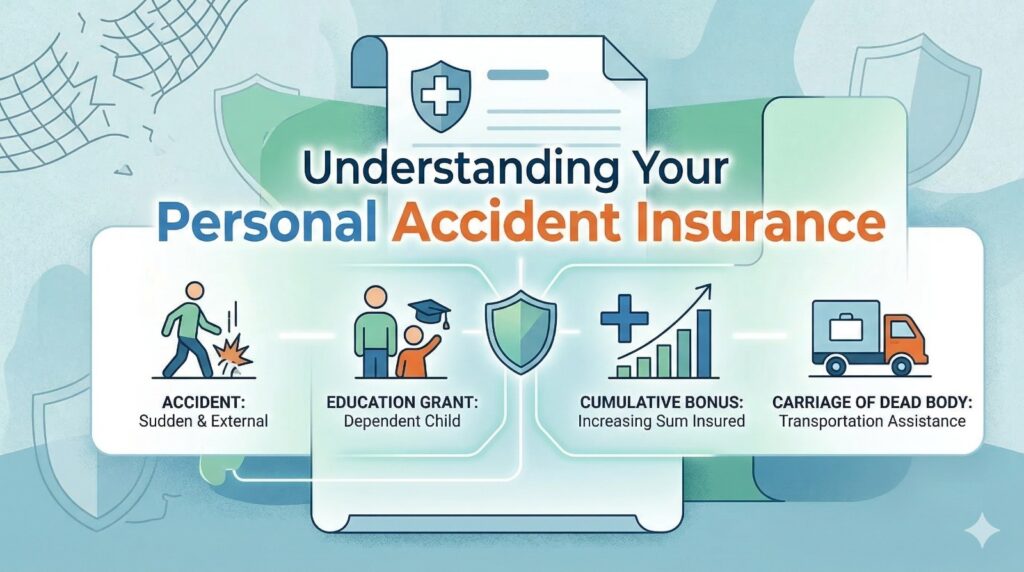
Purchasing a personal accident insurance policy is a critical step in financial planning, yet the “fine print” often remains a mystery to many policyholders. Understanding the nuances of these documents—governed by the Insurance Regulatory and Development Authority (IRDA)—is essential to ensure that you or your nominees can successfully navigate a claim during a difficult time.
Here is a breakdown of the key aspects every insured individual and their nominee should know.
1. What Qualifies as an “Accident”?
In insurance terms, an accident is not just any mishap. It is specifically defined as a sudden, unforeseen, and involuntary event caused by external, visible, and violent means. This means the injury must be a direct result of the accident and not caused by an underlying illness or disease.
2. Primary Benefits and Compensation
The policy typically offers a Capital Sum Insured (CSI), which is the maximum amount payable. Compensation is tiered based on the severity of the injury:
- Death: 100% of the CSI is paid if death occurs within 12 months of the accident.
- Permanent Total Disablement: If an injury permanently prevents you from engaging in any occupation, 100% of the CSI is provided.
- Loss of Limbs or Sight: Loss of both eyes or two limbs typically triggers a 100% payout, while the loss of one eye or one limb results in a 50% payout.
- Permanent Partial Disablement: Specific percentages are assigned to smaller losses, such as the loss of a finger or hearing in one ear.
3. Essential “Free” Benefits
Many are unaware of “Special Free Benefits” that may be included:
- Education Grant: If the insured suffers death or permanent total disablement, the policy may provide a grant for dependent children (under age 25).
- Carriage of Dead Body: A small percentage of the CSI (often capped at a specific amount) is provided to transport the deceased to their residence.
4. The “Cumulative Bonus”
If you do not make a claim during a policy year, you are often rewarded with a Cumulative Bonus. This increases your CSI by a certain percentage (e.g., 5%) for every claim-free year, usually up to a maximum of 50%. This bonus is preserved even during the Grace Period (typically 30 days) if the policy is renewed promptly.
5. Common Exclusions (What is NOT covered)
Insurance does not cover every scenario. Liability is generally excluded for:
- Self-inflicted injuries or suicide attempts.
- Accidents occurring while under the influence of alcohol or drugs.
- Injuries resulting from breach of law with criminal intent.
- Pregnancy-related complications or childbirth.
- War, nuclear radiation, or participation in aviation other than as a fare-paying passenger.
6. The Claims Process: Speed is Vital
In the event of an accident, immediate written notice must be given to the insurer. For fatal accidents, notice should ideally be given before cremation or burial.
Required Documents typically include:
- Duly completed claim form.
- Medical reports, X-rays, and police reports (FIR).
- For fatal cases: Death certificate, Post-mortem report, and Inquest report.
7. Your Right to Change Your Mind
Every new policy comes with a Free Look Period (usually 15 days). This allows you to review the terms; if you are unsatisfied, you can return the policy for a refund of the premium, minus proportionate risk charges.
(Disclaimer: This article is for general awareness only; readers should refer to their specific policy schedule and wordings, as coverage is subject to the terms, exclusions, and conditions of the individual insurance contract.)