
















Explore India’s 77-year democratic journey. From constitutional roots to becoming the world’s 4th largest economy, discover the evolution of “We, the People.”
Suresh Chandra Sarangi
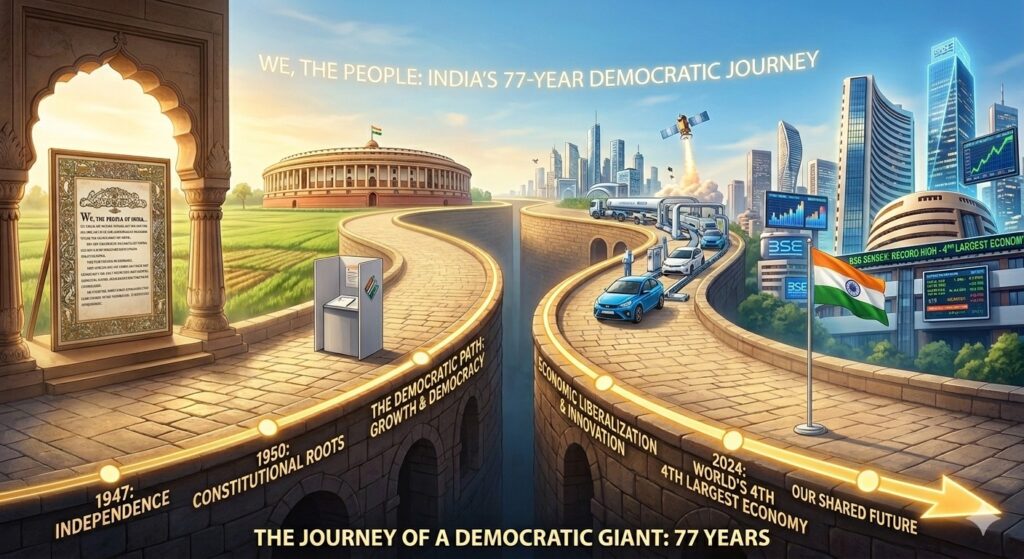
Friedrich Max Müller called India an “irresistible land” and the “real paradise on Earth.” As the world’s largest democracy, India’s Constitution begins with “We the People,” reflecting a unique system with a written Constitution, independent judiciary, and strong federal structure.
Still, the question arises, can we envision a society, despite the constitutional apparatus, to cherish India as a stable, democratic, modern, equitable, and just society? Through 77 years of tumultuous journey, India has been trying to decipher the true meaning of we, the people. Democracy, to many, may be imperfect in India, with all its infirmities, but it is precious, new, ascending, throwing the fragilities to the museum of antiquities. Our National flag is the symbol of our freedom and sovereignty. The people of India have expressed cognition and emotion and in the true sense of the term, we are argumentative and that is the bedrock of democracy, and our culture, politics, religion, economy and society have become stronger and evolved over the period, into a maturing democracy, throwing the whispers and reimagining India, which is the best part of the debate. A people, who practised untouchability, had the best guidelines in law,l to eliminate the same and bring right to equality and rule of law.
The preamble says that India will be a sovereign, democratic republic. That dream has been achieved. India has maintained its sovereignty, despite a few wars with Pakistan and one war with China in 1962, and consequent border skirmishes. The head of state, the president of India, is an elected person and thus, the word Republic is crucial. It is the largest functioning democracy, and the democratic tradition has been maintained truly since India became a Republic in 1950. That is the beauty of Indian democracy, and despite conflicts, terror, and disturbances, the elections to the Parliament and the State Assemblies have remained largely peaceful, and crores of Indian citizens have exercised their franchise through vote and kept the democratic flame burning with vigour and authenticity.
India is marching forward from independence to the global Information age. Gurucharan Das, in his book “India Unbound,” offers a ringside view of India’s progress with mesmerising economic and social transformation. India’s story is riveting; India’s continuous rise from poverty to economic prosperity is magical. Sweeping economic reforms have opened the floodgates of extraordinary growth.
The contemporary history of India has been action in development, competing, and forward-looking. What permeates through the constitution is the aspiration of millions of people. The constitution, through its preamble, promised justice, social, economic, and political. It also secures freedom of thought, expression, and belief, and ensures unity of the nation and dignity of the individual. The remarkable right that was enshrined in the Constitution to keep fundamental rights intact was the right to constitutional remedies. What was most important was the charter of rights, as echoed in the Magnakarta, the Universal Declaration of Human Rights, the French Revolution, and the Bill of Rights. This emphasized the importance of the people, and professed the idea of we the people.
When Britishers ruled the country, they plundered India, and India suffered the ignominy of abject poverty. What we achieved through independence was political democracy. But attainment of political democracy was meaningless without economic democracy, and the founding fathers aimed to transform the political democracy into economic democracy, through the charter of the Directive Principles of State policy. Gradually, the economic transformation is taking place. Now we have opted for inclusive growth and financial inclusion.
The country believed in the postulates of socialism and then democratic socialism. Now, it has been an effort to bring in competitive democracy by opting for a liberal economic order, a market economy, that is making India Unbound, making the Elephant dance and claim 4 th position in world ranking with the tag of the fastest growing democracy. Total equity remains a chimera, distributive justice has remained far from truth, inequality persists and is widening, yet economic democracy is functional.
Gurucharan Das writes,” the ascent of the country from poverty to prosperity, from tradition to modernity, is a great, fascinating story.” It is a free market economy and has begun to flex its muscle in the global economy. The struggle of one-sixth of humanity for its rightful place in the comity of nations is unfolding with vigour and momentum. The upward journey is palpable. Now the rise is dramatic and has captured the imagination of the world’s public.
The western nations that always made headlines about India as a nation of poverty and spirituality, by their instinct, are now understanding the socio-economic and scientific revolution, and a million mutinies like the UPI, the integration of big projects, and accretion in per capita income, with vibrant growth in public infrastructure. Politically, in international relations, India has been maintaining its strategic autonomy position, and despite Trump’s tariffs, India is weaving dreams like never before. Our cultural integration will help us grow and prosper in a world best with turbulence, uncertainty, war, and conflicts.
But we, the people, should learn humility and have complete faith in our self-reliance and resilience. Larry Summers says that the first quarter of the 21st century will be remembered in human history not for 9/11, but for the rise of China and India, an event which is momentous and profound. Indian society is more open today, embracing free trade and multiplying its connections to the world economy. But this is not all. Religious conflicts still dwarf our intention of a superpower status. The linguistic divide between North and South is quite palpable. Freedom and Swaraj, no doubt, have been achieved. Ganjiji’s Swaraj has to be brought, understood within its creative impulse. Sometimes, narrow divides like caste, religion, region, and language raise their ugly heads, and it is disturbing and not in consonance with the tenets of we, the people.
All that we have to remember is that our identity is that we believe in the concept of unity in diversity. Let us remember that the vision of a unified free, progressive India demands not just an intellectual commitment; it has to reflect a people’s life choices, it has to believe in the concept of plurality, harmonious coexistence. As Rabindra Nath Tagore has written, through his poem, “where the mind is without fear, fear” let us move into that borderless world. Then the spirit of the beginning word, “we, the people”, becomes not only a sentiment, but a reality.
(The writer is a former General Manager of Bank of India. Views expressed are personal.)