























Explore Odisha’s fiscal strategy for 2026-27. Learn how the state balances a ₹1.25 lakh crore debt with infrastructure goals and per capita liability
Madhusudan Mishra
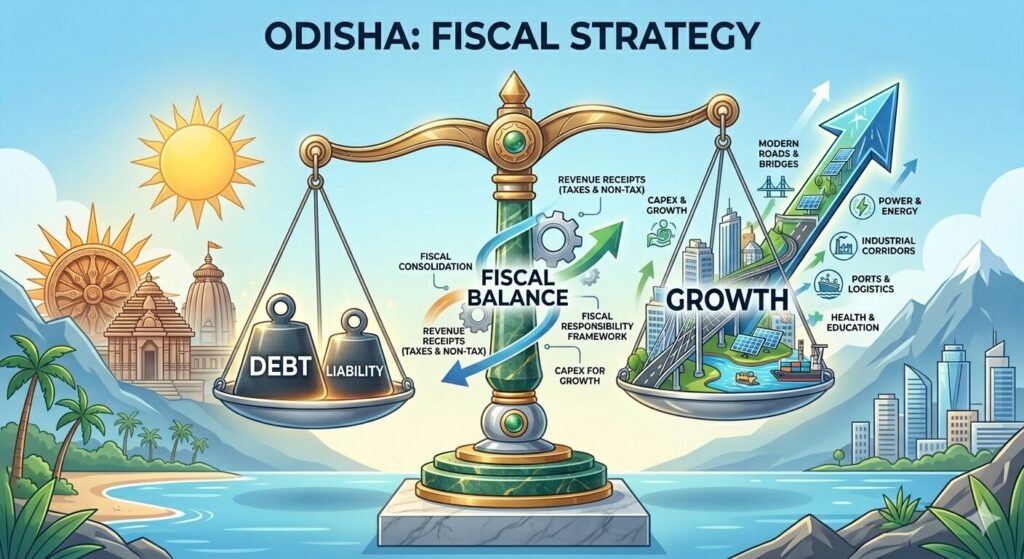
Odisha is at a critical juncture in its fiscal journey, where rapid development aspirations must be balanced with the rising public debt burden. As the state advances toward the financial year 2026–27, its economic strategy reflects both ambition and caution. With total outstanding debt reaching ₹1,25,951.30 crore and an estimated per capita liability of ₹26,738.33, Odisha’s fiscal position underscores the delicate balance between growth-led expenditure and long-term financial sustainability.
The government’s plan to borrow an additional ₹47,800 crore, while allocating ₹22,000 crore for repayment obligations—including ₹8,200 crore towards interest payments—highlights the complexity of fiscal management. These figures are not merely numerical indicators; they represent deeper structural challenges and strategic choices that will shape Odisha’s economic future.
It is important to recognize that public debt, in itself, is not inherently problematic. On the contrary, borrowing is often an essential tool for governments seeking to invest in infrastructure, expand social welfare programs, and stimulate economic growth. For a state like Odisha—marked by a dynamic industrial transformation, increasing urbanization, and persistent rural development needs—substantial capital investment is indispensable. Roads, irrigation networks, healthcare systems, educational institutions, and digital infrastructure all require sustained funding. In this context, borrowing catalyzes bridging developmental gaps and accelerating progress.
However, concerns arise when the scale and pace of borrowing exceed the state’s capacity to generate revenue and comfortably service its obligations. The fiscal projections for 2026–27 suggest a significant reliance on debt to sustain expenditure. While the allocation of ₹22,000 crore for repayments demonstrates a commitment to fiscal responsibility, the sizeable interest component of ₹8,200 crore indicates the growing cost of servicing existing liabilities. This trend reduces the fiscal space available for new developmental initiatives and risks creating a cycle where fresh borrowing is partially used to service past debt.
The per capita debt figure of ₹26,738.33, though not an immediate financial burden on individuals, serves as a critical indicator of the state’s fiscal health. It reflects the implicit liability that may be transferred to future generations if corrective measures are not implemented in time. As Odisha continues to strive for higher economic growth and improved human development outcomes, maintaining a prudent balance between borrowing and repayment becomes not just desirable but essential.
. Investments must generate tangible economic returns—either directly through revenue generation or indirectly by stimulating broader economic activity. Infrastructure projects, for example, should be evaluated not only on their immediate utility but also on their long-term impact on trade, employment, and industrial expansion. Similarly, investments in education and healthcare must translate into a more skilled, productive, and healthy workforce, thereby strengthening the state’s economic foundation.
Equally important is the need for robust revenue augmentation. Odisha has made notable progress in strengthening its tax collection mechanisms, particularly in sectors such as mining, industry, and goods and services tax. Expanding the tax base, enhancing compliance through digital governance, and minimizing leakages can significantly boost revenue inflows. Non-tax revenues—such as royalties from natural resources and returns from state-owned enterprises—also hold untapped potential and should be managed with greater efficiency and transparency.
Fiscal discipline must be reinforced through strategic prioritization of expenditure. Welfare schemes are vital for ensuring inclusive growth, but their design and implementation must emphasize targeted delivery and cost-effectiveness. Subsidies, in particular, should be rationalized to benefit the most vulnerable sections of society while minimizing unnecessary fiscal strain.
Public-private partnerships (PPPs) present a promising avenue for reducing the fiscal burden on the state while advancing critical infrastructure and service delivery projects. By leveraging private sector expertise, innovation, and capital, Odisha can accelerate development in sectors such as renewable energy, urban infrastructure, logistics, and tourism. Well-structured PPP models can enhance efficiency, improve project execution, and distribute financial risk more effectively.
Economic diversification will play a pivotal role in ensuring long-term fiscal stability. While Odisha has traditionally relied on mining and agriculture, emerging sectors such as manufacturing, tourism, information technology, and renewable energy offer significant growth potential. By fostering a conducive business environment, streamlining regulatory processes, and investing in skill development, the state can attract both domestic and foreign investment. This, in turn, will generate employment, expand the tax base, and strengthen revenue resilience.
Odisha must embrace innovation-driven growth strategies. Investments in digital economy initiatives, green technologies, and climate-resilient infrastructure can position the state as a forward-looking economy. Given the increasing importance of sustainability, aligning fiscal policy with environmental goals—such as promoting clean energy and sustainable resource management—can unlock new avenues of growth while mitigating long-term risks.
Refinancing high-cost debt, optimizing borrowing terms, and maintaining a sustainable debt-to-GSDP ratio are essential components of prudent fiscal governance. Transparency in debt reporting and adherence to fiscal responsibility frameworks will further enhance credibility, instill investor confidence, and support better decision-making.
The implications of public debt extend beyond balance sheets to influence the quality of public services, employment opportunities, and overall standards of living. A balanced approach that integrates fiscal prudence with social sensitivity is therefore crucial. Investments in education, healthcare, and social protection must remain safeguarded, even as efforts are made to rationalize expenditure and improve efficiency.
Looking ahead, Odisha’s fiscal trajectory will depend on its ability to align borrowing with growth-enhancing investments and ensure that debt remains within manageable limits. The current scenario, while challenging, also presents an opportunity for introspection and reform. With strategic planning, disciplined execution, and a clear long-term vision, the state can transform its fiscal pressures into a foundation for sustainable and inclusive development.
In conclusion, Odisha’s rising debt burden should not be viewed merely as a statistic, but as a call to action. It highlights the need for responsible governance, innovative policymaking, and a collective commitment to economic resilience. By strengthening revenue systems, optimizing expenditure, fostering private participation, and investing in future-ready sectors, Odisha can navigate its fiscal crossroads with confidence. The path ahead demands prudence, but it also offers immense promise.
(The author is a retired IAS officer. The views expressed are personal.)